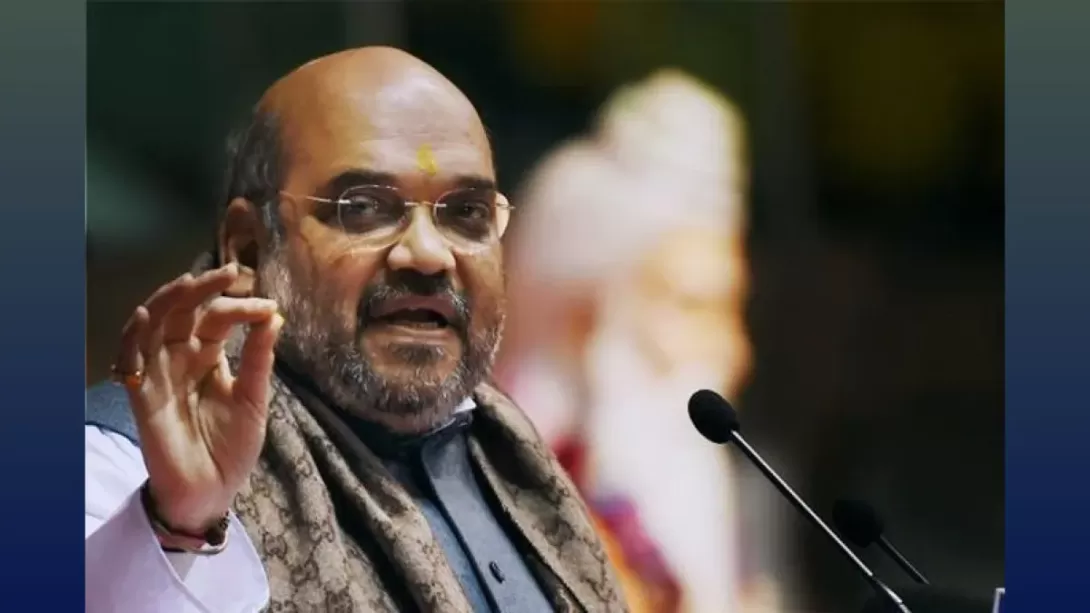
Union Home Minister Amit Shah, addressing the Maharashtra Chamber of Commerce, Industry and Agriculture (MACCIA), underscored the transformative impact of Rs. 7 lakh crore in infrastructure investments under the BJP-led Mahayuti government. Contrasting the current development trajectory with what he termed as a decade of neglect under the UPA regime, Shah credited projects like metro networks, expressways, ports, and irrigation schemes for revitalizing Mumbai and wider Maharashtra. He also highlighted the broader macroeconomic outlook, asserting India’s ascent to the world’s third-largest economy by FY27 and emphasized the role of business chambers in shaping policy and economic resilience amid global volatility.
A Developmental Reset for Mumbai
Union Home Minister Amit Shah lauded the BJP-led state and central administrations for fundamentally reshaping Mumbai’s urban and economic landscape. He attributed this transformation to the coordinated efforts of “double-engine” governance — Narendra Modi’s leadership at the Centre and Devendra Fadnavis and Eknath Shinde’s stewardship in Maharashtra.
According to Shah, over Rs. 7 lakh crore worth of infrastructure investments have been mobilized to modernize Mumbai, a city he once feared was succumbing to chronic issues like overcrowding, deteriorating housing stock, slums, and traffic congestion. These investments are aimed not just at surface-level improvements but at catalyzing long-term economic competitiveness.
Key Infrastructure Projects: Backbone of the Transformation
Among the flagship projects highlighted by Shah were:
- 337-km Mumbai Metro expansion with an outlay of Rs. 1.5 lakh crore
- Rs. 1.08 lakh crore Mumbai-Ahmedabad Bullet Train project
- Rs. 80,000 crore greenfield port at Wadhawan
- Rs. 17,000 crore Atal Setu trans-harbour link, enhancing connectivity
- Rs. 55,000 crore Versova-Virar sea-link, and
- Rs. 60,000 crore Virar-Alibag multimodal corridor
These projects, Shah argued, were conceived with a long-term vision absent during the UPA tenure. He also pointed out that if previous governments had pursued such initiatives, there would have been little left for the current administration to execute — a pointed remark targeting critics of the BJP’s infrastructure agenda.
Countering Criticism on Slum Redevelopment and Equity
Responding indirectly to criticism surrounding the Dharavi redevelopment project — which has faced scrutiny due to its association with the Adani Group — Shah emphasized that the BJP’s development model was not confined to elite infrastructure. He acknowledged the sensitivities around slum rehabilitation but stopped short of addressing specific allegations.
He further asserted that the BJP government’s focus extended beyond Mumbai. Infrastructure efforts included new airports in Shirdi and Sindhudurg, and massive investments in irrigation, which, he claimed, had helped eradicate the long-standing issue of farmer suicides in the state.
Fiscal Support: Doubling Down on Maharashtra
Refuting opposition claims of fiscal discrimination against Maharashtra, Shah presented data to support the Centre’s financial support to the state:
- Rs. 7.82 lakh crore in devolutions and grants from FY2014 to FY2024
- Compared to Rs. 1.91 lakh crore during the 2004–2014 UPA period
This surge in fiscal transfers, according to Shah, demonstrates the Centre’s prioritization of Maharashtra, especially for critical sectors such as infrastructure, irrigation, and industrial development.
Engaging Industry and Adapting to Global Shocks
Acknowledging the role of trade bodies, Shah urged industry chambers like MACCIA to actively engage with the government and evolve to stay relevant. He cited the example of lobby-driven initiatives like the Konkan Railway that spurred regional economic development.
With the backdrop of global disruptions — including the Russia-Ukraine conflict and the Israel-Iran tensions — Shah cautioned that domestic resilience must be anchored in agile policymaking and robust institutional cooperation. He encouraged MACCIA to infuse younger talent into its ranks and work with professional bodies to influence forward-looking policies.
India’s Growth Outlook: A Confident Projection
Projecting India’s economic ambitions, Shah claimed the country is on track to become the world’s third-largest economy by 2026–27, building on the foundations laid over the past 11 years. He called the last decade a period of “symmetric development,” suggesting that both urban centers like Mumbai and rural regions have benefited from policy-led investments.
Conclusion
Amit Shah’s address to Maharashtra’s business community was as much a policy briefing as it was a political pitch. By aligning infrastructural statistics with a vision for inclusive economic growth, he drew a clear distinction between past neglect and present ambition. Whether viewed through the lens of politics or policy, the message was unmistakable: Mumbai’s transformation is being engineered not by rhetoric, but by Rs. 7 lakh crore of capital-backed resolve.
Comments