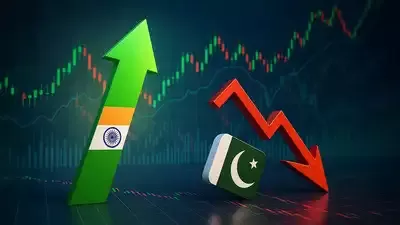
In the wake of escalating tensions between India and Pakistan following the tragic Pahalgam terror attack and the commencement of Operation Sindoor, financial markets in both nations have responded in starkly different ways. India’s Nifty50 exhibited a modest decline, reflecting the strength and stability of its vast economy, while Pakistan’s KSE-100 plunged sharply, revealing its fragility under geopolitical stress. This divergence underscores the economic resilience and market maturity of India, backed by deep capital markets, robust foreign exchange reserves, and investor confidence, in contrast to Pakistan’s limited liquidity and heightened vulnerability.
Market Reactions Signal Diverging Economic Realities
The immediate aftermath of rising hostilities along the India-Pakistan border has produced markedly different responses from the stock markets in both countries. Since the launch of Operation Sindoor on May 7, India’s Nifty50 index has registered a minor 1.52% dip—a reflection of caution rather than alarm. In sharp contrast, Pakistan’s KSE-100 index recorded a steep decline of 5.55%, further intensifying a downward trend that began with the April 22 Pahalgam terror attack, which tragically claimed 26 lives.
Since that attack, Pakistan's KSE-100 has cumulatively lost 9.5% of its value, whereas India’s benchmark index has shown remarkable resilience with only a 0.66% decrease over the same period. These figures highlight the contrasting economic fundamentals and investor sentiments underpinning both markets.
India’s Deep Capital Markets Provide a Cushion
India’s financial ecosystem exhibits significantly more depth, diversity, and institutional maturity than its regional counterpart. With a market capitalization nearing $5 trillion, India ranks among the top five equity markets globally, boasting over 5,000 listed companies. This expansive landscape is supported by strong participation from mutual funds, retail investors, and systematic investment plans (SIPs), which collectively anchor market sentiment even during episodes of geopolitical instability.
Conversely, Pakistan’s Karachi Stock Exchange, with a market cap of just $20.36 billion, hosts fewer than 500 companies, offering limited liquidity and breadth. This lack of depth amplifies investor panic and market swings during periods of uncertainty, as seen in the recent sell-off.
Forex Reserves and Macro Fundamentals Tell a Bigger Story
India’s macroeconomic strength is further exemplified by its foreign exchange reserves of $688 billion, which provide a significant buffer against external shocks and currency volatility. Pakistan, on the other hand, holds just $15.25 billion in reserves, a precarious position that leaves it highly exposed to capital flight and inflationary pressures.
Moreover, India is poised to overtake Japan as the world’s fourth-largest economy by 2025, with projections suggesting it will reach the third position by 2028. This anticipated growth trajectory reaffirms global investor confidence in India’s structural fundamentals.
Pakistan, in stark contrast, does not feature among the top 40 global economies by nominal GDP, highlighting the scale of its economic challenges. In the event of a prolonged military conflict, the financial consequences for Pakistan would be significantly more severe, potentially derailing its already fragile economy.
Strategic Stability Through Economic Strength
The recent divergence in market performance underscores the broader geopolitical calculus at play. Analysts argue that India’s economic robustness allows it to absorb shocks with limited disruption, whereas Pakistan’s vulnerability acts as a deterrent against prolonged escalations. In essence, economic resilience translates into strategic leverage.
As financial markets increasingly reflect geopolitical stability and national economic health, India’s measured market reaction serves not only as a signal to investors but also as a testament to its growing global stature.
Conclusion: A Tale of Two Economies in Turbulent Times
While border tensions and security concerns dominate headlines, the real story is unfolding in the financial markets. The resilience of India’s stock market, amidst regional instability, is a manifestation of its economic might, institutional maturity, and investor confidence. Pakistan’s steep market decline, on the other hand, reveals the limitations of a constrained economic model struggling to cope with external shocks.
In a world where economic strength underpins geopolitical influence, India continues to consolidate its position as a regional powerhouse with global aspirations—while Pakistan faces a sobering reality check.
Comments