India’s top military leadership reaffirmed on Monday that the nation’s recent cross-border offensive—Operation Sindoor—was strictly aimed at dismantling terrorist networks operating within Pakistan-Occupied Kashmir (PoK). Rejecting allegations of escalation, Indian officials emphasized that their actions were retaliatory and precise, focused solely on terror camps and not directed at Pakistan’s military. Air Marshal A.K. Bharti attributed any Pakistani casualties to Islamabad’s decision to align itself with extremist elements. With India’s multi-layered air defence system successfully repelling threats, the operation underlined New Delhi’s resolve to protect its sovereignty while minimizing collateral damage.
India Reiterates Terror-Focused Military Objective
In a detailed media briefing held in New Delhi, senior Indian military officials clarified that Operation Sindoor, launched on May 7, was designed exclusively to neutralize terrorist infrastructure within Pakistan-Occupied Kashmir (PoK). Air Marshal A.K. Bharti, addressing the press, underscored that India had deliberately avoided targeting Pakistan’s armed forces, despite provocative circumstances.
“Our objective was precise and limited—to dismantle terror camps threatening India’s national security. Unfortunately, Pakistan’s military chose to involve itself in this operation, effectively turning a counterterrorism response into a broader confrontation. They must bear the responsibility for the consequences,” said Bharti.
This pointed statement signals a broader shift in India’s strategic messaging, emphasizing both restraint and readiness in the face of asymmetric threats.
Pakistan's Military Criticized for Aligning With Extremists
India’s armed forces stopped short of accusing Islamabad of direct provocation but highlighted the consequences of Pakistan’s decision to shelter and support terrorist outfits. By positioning itself alongside militants, Pakistan's military blurred the lines between state and non-state actors, officials asserted.
“This wasn’t an attack on the Pakistani state, nor its military installations. However, when the Pakistani armed forces choose to shield or even defend terrorist groups, they compromise their own national interest,” said a high-ranking official familiar with the operation’s planning.
This narrative positions India as a responsible regional actor reacting to provocations, while casting doubt on Pakistan’s commitment to dismantling terror networks operating from its soil.
Strengthening Air Defence Capabilities
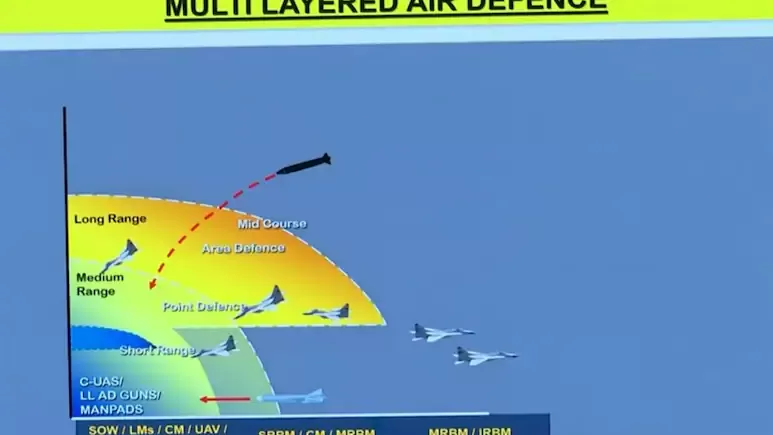
India’s robust air defence architecture played a crucial role in protecting both civilian populations and strategic infrastructure during the cross-border tensions. “Our air defence system stood like a wall—resilient, integrated, and impenetrable,” noted Air Marshal Bharti.
The Indian military deployed a multi-layered air shield capable of detecting, intercepting, and neutralizing threats with precision. This included early warning systems, surface-to-air missile platforms, and integrated radar networks.
The success of these systems during Operation Sindoor has reportedly prompted discussions about further modernizing India’s defensive capabilities, particularly in light of evolving drone and missile threats from across the border.
Civilian and Military Infrastructure Safeguarded
One of the key takeaways from the briefing was the Indian military’s ability to conduct high-risk operations with minimal disruption to civilian life. Air Marshal Bharti stressed that the armed forces took every precaution to prevent unnecessary damage.
“India’s commitment to protecting civilian infrastructure, even amid active engagements, remains unwavering. Precision strikes and pre-emptive planning ensured that the impact was confined to militant targets,” he stated.
Military analysts have applauded this approach as a model for 21st-century conflict engagement—one that emphasizes surgical precision and geopolitical responsibility.
Strategic Implications and Regional Stability
The broader ramifications of Operation Sindoor lie not just in its tactical success but in the clear message it sends to both regional adversaries and international observers. By drawing a hard line between counterterrorism and inter-state conflict, India seeks to project a doctrine of controlled force: resolute, but measured.
The presence of senior figures such as Director General of Military Operations Lt. Gen. Rajiv Ghai, Vice Admiral A.N. Pramod, and Maj. Gen. S.S. Sharda at the briefing added weight to the government's unified stance.
As tensions simmer in the subcontinent, India's leadership appears focused on shaping the narrative—ensuring that deterrence, not escalation, guides its military calculus.
Comments