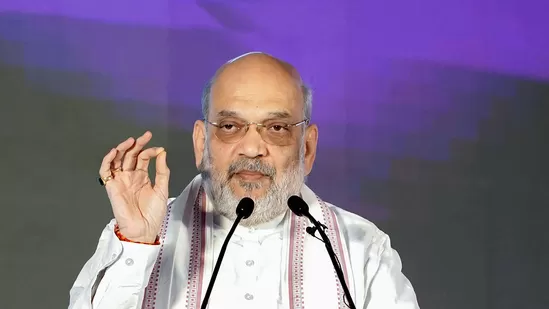
Union Home Minister Amit Shah has vowed to take decisive action against those responsible for the terrorist attack in Jammu and Kashmir’s Pahalgam, which claimed the lives of 26 civilians. Speaking at a public event in Delhi, Shah stated that the perpetrators would not escape justice, emphasizing the Indian government’s resolve to eliminate terrorism. His remarks come amid escalating tensions with Pakistan, as investigations suggest possible cross-border involvement in the attack. The statement signals the Indian government’s firm stance on combating terrorism and its broader geopolitical implications.
India Vows Justice for Victims of Pahalgam Terror Attack
On April 22, 2025, a terrorist attack in Jammu and Kashmir’s Pahalgam region led to the tragic loss of 26 civilian lives. In response, Union Home Minister Amit Shah delivered a stern warning to those responsible for the attack, stating that India would relentlessly pursue each and every individual involved in the heinous act. This marked Shah’s first public statement regarding the terror attack, and his comments were laden with strong promises of retribution.
In an event held in Delhi, Shah made it clear that the perpetrators would face severe consequences, asserting that the Indian government’s resolve to uproot terrorism from the country remains unshaken. He warned, "We will hunt down each and every perpetrator of the Pahalgam terror attack. Don’t think that you have won by killing 26 people. Every one of you will be made answerable."
Stronger Measures Against Terrorism
Shah further emphasized that the government under Prime Minister Narendra Modi was committed to a zero-tolerance policy on terrorism, pointing out that those responsible for the Pahalgam attack would not go unpunished. "Har vyakti ko chun chun ke jawab bhi milega, jawab bhi diya jayega... This is the Narendra Modi government; no one will be spared. It is our resolve to uproot terrorism from every inch of this country and it will be accomplished," Shah declared.
His comments underscore the Indian government’s increased vigilance in confronting terrorist activities, both domestically and across its borders. The Pahalgam attack has been viewed as a stark reminder of the persistent threat posed by terrorism in the region, and Shah’s message is aimed at reaffirming India’s commitment to national security.
Rising Tensions Between India and Pakistan
The Pahalgam attack has added fuel to the already simmering tensions between India and Pakistan. Investigations into the incident have revealed that there may be cross-border linkages to the attack, a factor that has raised concerns about Pakistan’s involvement or complicity in the assault. The Cabinet Committee on Security (CCS), chaired by Prime Minister Narendra Modi, convened shortly after the attack to review the situation and discuss possible retaliatory measures. During this meeting, CCS officials were briefed about the suspected cross-border connections, further exacerbating diplomatic strains between the two neighboring countries.
The growing tension between India and Pakistan is reminiscent of the events of February 2019, when India conducted an airstrike on a terrorist camp deep inside Pakistan-Occupied Kashmir (PoK) in retaliation for the suicide bombing in Pulwama. The attack, which targeted a convoy of the Central Reserve Police Force (CRPF), marked one of the most significant escalations in recent years, and the Pahalgam assault has the potential to spark a similar escalation in hostilities.
Political and Public Reactions
The public outpouring of support for the victims of the Pahalgam attack has been accompanied by widespread calls for stronger action against terrorism, both within India and beyond. At the Delhi event, Amit Shah was joined by Delhi Lieutenant Governor VK Saxena, Chief Minister Rekha Gupta, Assam Chief Minister Himanta Biswa Sarma, and Bodoland Territorial Council Chief Executive Member Promod Boro, among others, who collectively observed a moment of silence in honor of the victims.
Shah’s remarks resonate deeply with a public that has grown increasingly frustrated with the persistent threat of terrorism. His unequivocal commitment to holding those responsible accountable reinforces a sense of resolve within the Indian government, bolstering its position on national security and its readiness to respond forcefully to external threats.
Diplomatic and Military Implications
The Pahalgam terror attack and the subsequent statements from India’s leadership signal that India is likely to intensify its counterterrorism efforts. The possible involvement of cross-border elements further complicates India-Pakistan relations, especially considering the already fraught history between the two nuclear-armed nations. With both sides closely monitoring developments, the incident may serve as a catalyst for further military and diplomatic actions.
In the coming weeks, the Indian government may ramp up its counterterrorism operations within Jammu and Kashmir and along the international border. Additionally, there may be renewed efforts at the diplomatic level to hold Pakistan accountable for the alleged involvement of its soil in harboring terrorism against India.
Conclusion: India’s Firm Stance on Terrorism
Amit Shah’s decisive language and unwavering commitment to combat terrorism reflect the Indian government’s broader strategic goals: to root out terrorism within its borders and prevent any external support for such activities. The Pahalgam attack is not just an isolated tragedy; it is a reminder of the continuing security challenges that India faces. Shah’s public assurance of justice for the victims and his promise to "hunt down" those responsible are a testament to India’s growing resolve to confront terrorism head-on—no matter the cost.
As tensions continue to rise, the global community will be watching closely to see how the situation unfolds. India’s actions in the aftermath of the Pahalgam attack will likely shape not only its domestic security policies but also its international relations, particularly with its neighbor Pakistan. The coming weeks could prove crucial in determining the future course of action in the ongoing fight against terrorism in the region.
Comments