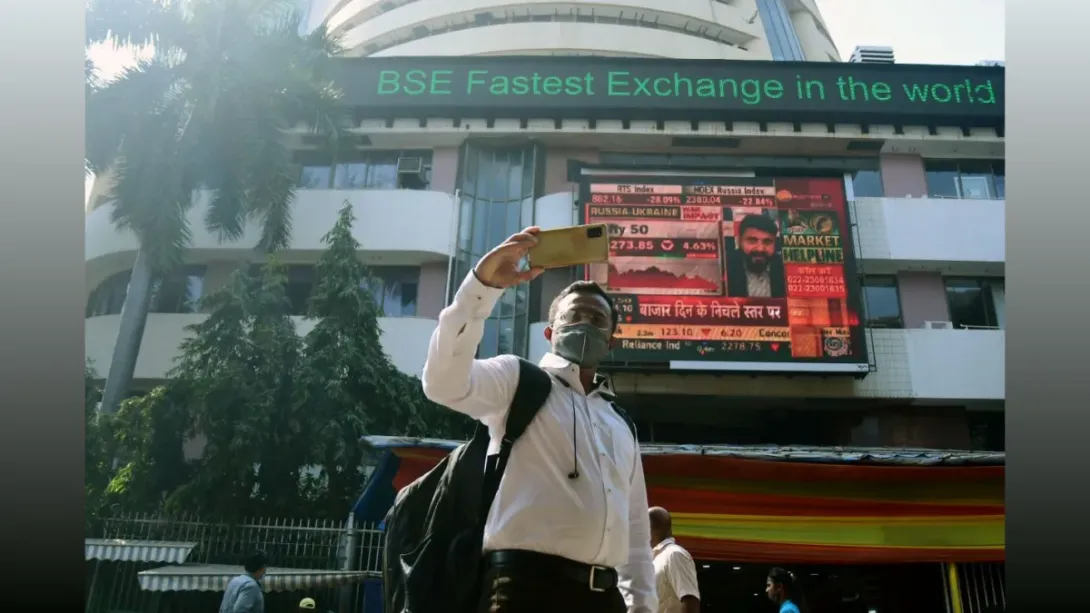
Indian equity benchmarks closed lower as sustained foreign institutional investor (FII) outflows weighed on market sentiment. Both the Sensex and the Nifty ended in the red, reflecting cautious investor positioning amid global uncertainty, rising bond yields, and concerns over valuation comfort. While select domestic stocks showed resilience, broader indices struggled to find support as overseas investors continued to pare exposure to emerging markets, including India. Analysts note that the decline is less about domestic fundamentals and more a response to global capital flows, currency movements, and shifting risk appetite across international markets.
Benchmark Indices Under Pressure
The Indian stock market witnessed a subdued session as the Sensex and the Nifty slipped amid persistent selling by foreign investors. The retreat followed a familiar pattern seen in recent sessions, where early stability gave way to gradual erosion as institutional selling intensified.
Market participants pointed to FII withdrawals as the primary driver behind the weakness. Large-cap stocks, particularly in banking, information technology, and metals, bore the brunt of the selling pressure, dragging benchmark indices lower despite selective buying in defensive pockets.
Foreign Capital Flows Shape Sentiment
Foreign investors have remained net sellers of Indian equities, reflecting a broader reallocation of capital toward developed markets. Higher interest rates in advanced economies and elevated U.S. bond yields have reduced the relative attractiveness of emerging market assets.
Currency considerations have also played a role. A firmer U.S. dollar tends to pressure emerging market currencies, prompting overseas investors to adopt a risk-off approach. Analysts argue that such outflows, while disruptive in the short term, are cyclical rather than structural and do not necessarily signal a deterioration in India’s economic outlook.
Domestic Factors Offer Partial Support
Despite the headline decline, domestic institutional investors provided some counterbalance, selectively accumulating quality stocks on dips. Strong macroeconomic indicators, stable inflation trends, and expectations of steady earnings growth continue to underpin medium- to long-term confidence in Indian equities.
Sectors linked to consumption and infrastructure showed relative resilience, supported by expectations of sustained government spending and improving rural demand. However, these positives were insufficient to offset the scale of foreign selling during the session.
Outlook: Volatility Likely to Persist
Market strategists expect near-term volatility to remain elevated as global cues continue to influence capital flows. Key triggers include movements in global interest rates, geopolitical developments, and upcoming economic data from major economies.
While short-term corrections may test investor patience, analysts maintain that structurally strong fundamentals and India’s growth premium could reassert themselves once global conditions stabilize. For long-term investors, periods of FII-led declines are increasingly viewed as opportunities rather than signals to exit.
Comments