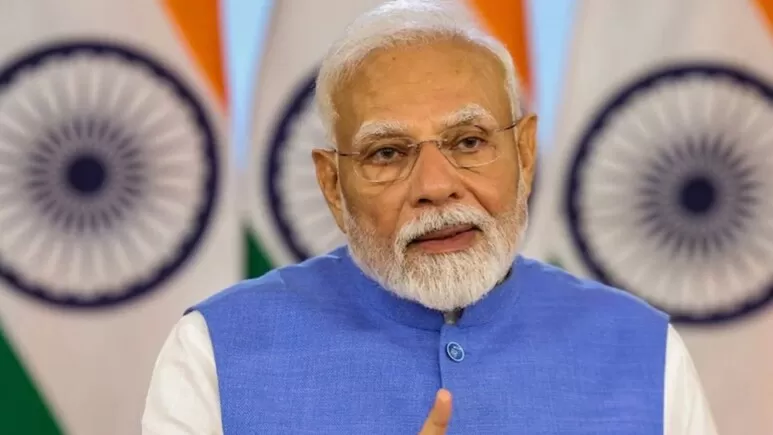
India has signaled a dramatic recalibration in its national security doctrine following a wave of escalated hostilities with Pakistan. Prime Minister Narendra Modi’s directive to the armed forces was unequivocal: every hostile act must be met with a stronger, proportionate response. This led to Operation Sindoor, a series of precision airstrikes on key Pakistani military targets, following Islamabad's drone-led offensives. As India asserts a "new normal" in dealing with cross-border terrorism, it has rejected third-party mediation—reaffirming that the only issue worth discussing is Pakistan’s withdrawal from illegally occupied territories in Kashmir.
Modi’s Directive: From Deterrence to Decisive Retaliation
In a message that reflects India’s hardened security stance, Prime Minister Narendra Modi instructed military leadership to adopt an assertive posture toward cross-border aggression. According to senior government sources, Modi’s words were clear: “Wahan se goli chalegi, yahan se gola chalega”—a bullet from across the border will be met with artillery from this side.
This doctrine came into sharp focus during Operation Sindoor, India’s carefully coordinated military campaign targeting key Pakistani military installations. The operation was initiated in response to Pakistan’s escalation of drone and artillery strikes across India's northern and western frontiers.
Precision Strikes: A Tactical Response to Provocation
The Indian Air Force executed high-precision strikes using air-launched weaponry from its fighter jets. The targets included military air bases at Rafiqui, Murid, Chaklala, Rahim Yar Khan, Sukkur, and Chunian. Additionally, radar installations at Pasrur and the Sialkot aviation base were neutralized, dealing a significant blow to Pakistan’s aerial surveillance and strike capabilities.
These actions marked a decisive break from previous response frameworks. Rather than resorting to restraint or diplomatic signaling alone, New Delhi’s operational response aimed to dismantle the infrastructure supporting terrorist activity while deterring future aggression.
Operation Sindoor: A Continuing Doctrine, Not a One-Off
Government officials emphasized that Operation Sindoor remains active and represents a “new normal” in India’s cross-border engagement strategy. There will be “no business as usual,” they said, underscoring a long-term commitment to enforcing greater costs on sponsors of terrorism.
“This is not about retaliation for a single incident. It is a strategic posture—cross-border terrorism cannot coexist with selective engagement,” a senior official remarked. The implication is that India will no longer tolerate parallel tracks of dialogue and conflict, a stance that reshapes regional diplomacy.
India's Position on Mediation and Kashmir
Amid global calls for mediation, India reaffirmed its longstanding position on Kashmir. When U.S. President Donald Trump offered to mediate the Kashmir issue between India and Pakistan—posting a conciliatory message on Truth Social—Indian authorities firmly rejected the notion of third-party involvement.
“There is no question of mediation,” government sources stated. “The only item for discussion is Pakistan returning the territory it occupies illegally.” This policy underscores India’s insistence on bilateralism as laid out in the 1972 Simla Agreement and maintains sovereignty as non-negotiable.
Moreover, India has made it clear that all formal communication with Pakistan will be channeled exclusively through the Director General of Military Operations (DGMO), ruling out political or diplomatic engagement until fundamental issues of terrorism are addressed.
Conclusion: Redefining Strategic Boundaries
India’s evolving military and diplomatic posture reflects a broader recalibration of its national defense strategy. Through Operation Sindoor, New Delhi has moved from strategic ambiguity to calibrated assertiveness—demonstrating its resolve to impose tangible consequences for cross-border hostilities.
By rejecting external mediation and insisting on accountability, India is reshaping the dialogue on South Asian security. As geopolitical tensions remain high, one message has emerged unequivocally: India will no longer operate under old paradigms in responding to threats against its sovereignty.
Comments