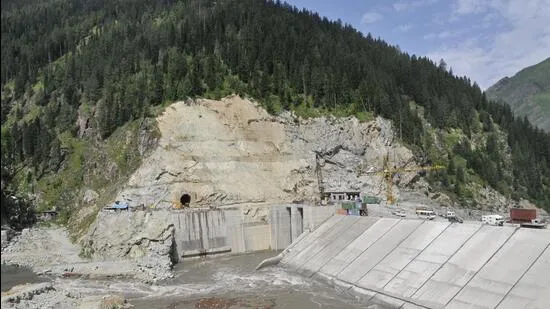
India has unequivocally rejected the ruling of the Permanent Court of Arbitration (PCA) in The Hague, which affirmed the court’s competence to hear Pakistan’s objections related to India’s Kishenganga and Ratle hydropower projects. India's External Affairs Ministry declared that it does not recognize the PCA's legitimacy, especially after suspending the Indus Waters Treaty with Pakistan in April 2023. This development follows a diplomatic escalation between the two nations, with Pakistan continuing to seek legal remedies through international arbitration, while India insists that its sovereign actions regarding the treaty are immune to external legal scrutiny.
India Challenges PCA’s Jurisdiction in Dispute Over Hydropower Projects
On Friday, the Indian government responded strongly to a ruling by the Permanent Court of Arbitration (PCA) in The Hague, which upheld the court’s authority to adjudicate Pakistan’s objections to India’s Kishenganga and Ratle hydropower projects. The ruling, which was made in the context of the 1960 Indus Waters Treaty, was swiftly rejected by India, with the Ministry of External Affairs issuing a statement reiterating its position that the PCA is not legally recognized by New Delhi. India further criticized the court’s ruling as a violation of the treaty itself.
Dispute Background: Hydropower Projects and Pakistan’s Objections
The dispute between India and Pakistan over the Kishenganga (330 MW) and Ratle (850 MW) hydropower projects dates back to 2015. Pakistan raised concerns regarding the design and operation of these projects, particularly regarding their impact on water flow in rivers allocated to Pakistan under the Indus Waters Treaty. Although India maintains that the projects comply with the treaty, Pakistan sought the intervention of a neutral expert to resolve the issues. However, after retracting this request in 2016, Pakistan demanded the constitution of a Court of Arbitration.
India has consistently boycotted the PCA’s involvement in the matter, asserting that the establishment of such a court constitutes a violation of the treaty’s provisions. In its defense, India argues that there is a designated mechanism for dispute resolution under the Indus Waters Treaty and that two separate dispute resolution channels—one through a neutral expert and the other through a Court of Arbitration—cannot be simultaneously pursued.
The April 2023 Suspension: India’s Assertion of Sovereignty
The root of the current escalation lies in India’s decision to suspend the Indus Waters Treaty in April 2023. This move came in the aftermath of the deadly terror attack in Pahalgam, Jammu and Kashmir, which claimed the lives of 26 civilians. Foreign Secretary Vikram Misri, speaking at the time, emphasized that India’s decision to hold the treaty "in abeyance" was contingent upon Pakistan permanently renouncing support for cross-border terrorism.
India’s suspension of the treaty, which governs water usage between the two countries, has significantly impacted the ongoing dispute over the hydropower projects. By placing the treaty in abeyance, India effectively suspended its obligations under the agreement, including those concerning the disputed projects.
PCA Ruling: India Dismisses the Court’s Authority
On Friday, the PCA issued a ruling confirming its competence to continue hearing the dispute, despite India’s suspension of the treaty. The court's ruling came with the stipulation that its decision is binding and cannot be appealed. India, however, rejected this “so-called supplemental award” in a strongly worded statement.
The External Affairs Ministry reiterated that India has "never recognized the existence in law" of the PCA, and therefore, does not accept the court’s jurisdiction or its rulings. India’s stance remains firm that the PCA’s formation was an unlawful act and that any proceedings or decisions taken by the court are illegal and void.
Legal Implications: India’s Sovereign Rights vs. International Arbitration
India’s rejection of the PCA ruling rests on its claim that the court’s actions are in breach of the Indus Waters Treaty. The Ministry’s statement emphasized that India’s decision to suspend the treaty was a sovereign act, and no international court—least of all an illegally constituted one—has the authority to challenge the legality of such a decision.
India’s position is rooted in its belief that it acted within its rights under international law, and that no external body, including the PCA, can adjudicate its sovereign decisions. As per the Ministry’s statement, "Until such time that the Treaty is in abeyance, India is no longer bound to perform any of its obligations under the Treaty." Therefore, India asserts that it is free to manage its water resources and related infrastructure without interference.
Pakistan’s Response: Continued Pursuit of Legal Action
In contrast, Pakistan has remained resolute in its belief that India’s actions are a violation of the Indus Waters Treaty, which allocated the rights to the western rivers (Indus, Jhelum, and Chenab) to Pakistan and the eastern rivers (Ravi, Beas, and Sutlej) to India. Pakistan has argued that any diversion or obstruction of the allocated rivers by India, including through the Kishenganga and Ratle projects, would be considered an "act of war."
Pakistan’s leadership has continued to explore legal avenues for challenging India’s suspension of the treaty, and has signaled its intent to pursue the matter in international courts, including both the PCA and the International Court of Justice (ICJ). Pakistan’s persistent efforts to seek redress through international arbitration have, however, been rejected by India, which views them as part of Pakistan’s broader strategy to undermine India's sovereign rights.
The Political Context: Broader Diplomatic Strains
The ongoing dispute over the Indus Waters Treaty and the hydropower projects is situated within a broader geopolitical context of strained relations between India and Pakistan. While both nations have made occasional overtures towards dialogue, their ties remain deeply contentious, especially regarding issues of cross-border terrorism and military engagements.
India’s rejection of international arbitration is also a reflection of its growing skepticism towards multilateral forums that it perceives as being influenced by external political considerations. The situation is further complicated by the complex diplomatic and military dynamics that influence bilateral relations between the two nuclear-armed neighbors.
Conclusion: A Deadlock on the Horizon
The disagreement between India and Pakistan over the Indus Waters Treaty and the Kishenganga and Ratle hydropower projects is far from resolution. India’s suspension of the treaty has placed it at odds with Pakistan’s legal claims, while the PCA’s role in the dispute remains a point of contention. Both nations are entrenched in their positions, with India asserting its sovereign rights and Pakistan seeking accountability for what it views as violations of the treaty.
As the situation evolves, it is likely that the dispute will continue to escalate, with potential implications not only for the hydropower projects but for the broader relationship between the two countries. Whether international arbitration can play a constructive role in this dispute, or whether bilateral diplomacy will eventually prevail, remains uncertain. The challenge now lies in navigating the complex legal, diplomatic, and environmental factors at play in one of South Asia’s most contentious water-sharing disputes.
Comments