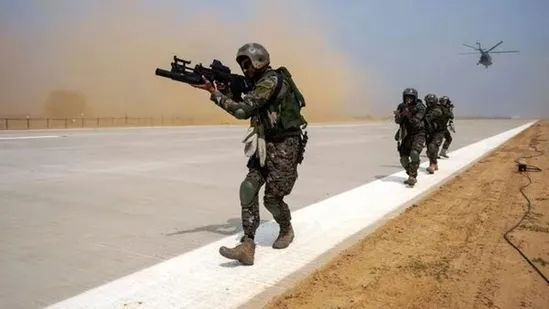
India’s recent military operation, codenamed Operation Sindoor, marked one of the most significant direct confrontations with Pakistan in recent years, following the Pahalgam terror attack. The initial losses—of both aircraft and personnel—have stirred debate over the political constraints imposed on the armed forces at the outset. As Indian defense officials revealed during separate international forums, initial orders to avoid targeting Pakistani military assets may have compromised tactical advantage. However, a swift strategic pivot led to overwhelming Indian air superiority. The episode underscores the delicate balance between political restraint and operational effectiveness in modern warfare.
Opening Salvo: Losses Amid Constraints
India's initial losses during Operation Sindoor—including advanced fighter jets such as Rafales and a Sukhoi-30—have sparked serious questions about the government's initial rules of engagement. According to Captain Shiv Kumar, a senior naval officer and defense attaché to Indonesia, Indian pilots operated under strict directives: strike only terrorist infrastructure, not military or civilian assets within Pakistan.
This directive, he argued, placed Indian forces at a disadvantage in the opening stages of the operation, resulting in the loss of multiple aircraft and a tactical drone. While Kumar did not confirm the exact number, his remarks—delivered at a defense seminar in Jakarta—were in response to claims by Indonesian aerospace experts that India lost five aircraft and two S-400 air defense systems.
Strategic Recalibration: From Caution to Dominance
Following the early setbacks, India swiftly shifted its operational tactics. “We changed tack,” Captain Kumar stated, noting that Indian forces then undertook Suppression of Enemy Air Defenses (SEAD) and Destruction of Enemy Air Defenses (DEAD) missions, standard military strategies to clear the skies of hostile air threats. These missions paved the way for precision strikes deep inside Pakistani territory, achieving full air superiority between May 8 and May 10.
This pivot highlights the Indian Air Force’s (IAF) flexibility in real-time combat scenarios. By targeting radar installations, missile batteries, and command centers, Indian jets could operate with increased confidence, enabling successive waves of attacks to dismantle terror networks and supply chains in both Pakistan and Pakistan-occupied Kashmir (PoK).
Diplomatic Messaging and the Role of Civilian Control
The Indian Embassy in Jakarta responded to the controversy by clarifying that Kumar's remarks were misrepresented. According to their statement, his presentation emphasized the constitutional primacy of civilian control over the military—a hallmark of Indian democracy—unlike some of its regional neighbors.
While no official government response has been issued regarding aircraft losses, the commentary from uniformed officers abroad reveals the evolving nature of modern military diplomacy, where battlefield transparency is increasingly demanded by both global observers and domestic constituencies.
Pakistan’s Response and Rapid Collapse
Pakistan responded with Operation Bunyan-um-Marsoos, a military retaliation that, according to Indian defense officials, was neutralized within eight hours on May 10. Chief of Defence Staff General Anil Chauhan, speaking earlier in Singapore, described the Pakistani counteroffensive as "ambitious but short-lived," adding that India’s revised strategy rendered it ineffective.
Indonesian defense analyst Tommy Tamtomo claimed Pakistani losses were significant, including six fighter jets, two AWACS (airborne warning and control system) aircraft, and a military transport plane. If verified, these numbers would indicate a severe degradation of Pakistan’s air combat capability.
Political Fallout and Opposition Criticism
The lack of a formal government statement has drawn fire from opposition parties. Congress MP Jairam Ramesh criticized the prime minister’s silence and questioned why no special parliamentary session had been convened to discuss Operation Sindoor. He noted that senior defense officials had spoken publicly abroad while elected representatives at home were left in the dark.
This raises broader concerns about transparency, especially when national security actions result in the loss of lives and high-value military assets. In democracies, strategic decisions are expected to be debated and scrutinized—particularly when they involve escalation across volatile borders.
Operational Takeaways: Lessons in Modern Combat
Operation Sindoor offers multiple lessons for both policymakers and military strategists:
- Clarity in Rules of Engagement: Political directives must strike a balance between restraint and operational latitude. Overly restrictive orders in a high-threat environment can jeopardize both mission success and personnel safety.
- Importance of Electronic Warfare: The reported disconnect in India’s AWACS support during initial sorties—allegedly contributing to Rafale losses—underscores the critical role of battlefield coordination, surveillance, and real-time data-sharing.
- Adaptability of Air Power: The IAF’s ability to regain momentum and dominate the skies within 48 hours demonstrates operational resilience and strong command capabilities.
- Public Communication Strategy: In a digital age, controlling the narrative is vital. Disparate statements from military leaders without official briefings create an information vacuum that can be politically and diplomatically counterproductive.
Conclusion: Strategic Triumph Amid Tactical Turbulence
Despite early missteps, India’s Operation Sindoor achieved its stated goal—neutralizing terror hubs across the border without initiating a full-scale war. However, the episode has illuminated underlying vulnerabilities, both in battlefield coordination and in civil-military communication protocols. As India continues to refine its defense posture, these lessons will prove invaluable in preparing for future conflicts in an era marked by asymmetric threats and rapid escalations.
Comments