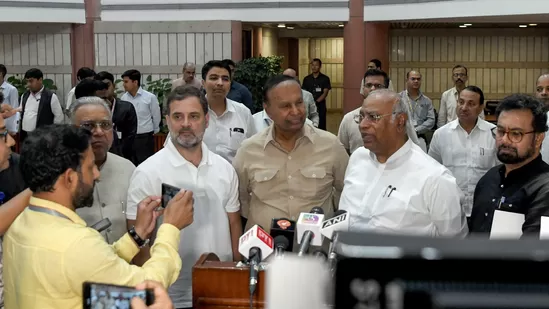
Amid escalating geopolitical tensions and a fragile ceasefire between India and Pakistan, Congress leader Rahul Gandhi has formally urged Prime Minister Narendra Modi to convene a special session of Parliament. The call, echoed by Congress President Mallikarjun Kharge, seeks urgent deliberation on three critical developments: the Pahalgam terror attack, India's retaliatory Operation Sindoor, and the recently announced ceasefire. This political demand reflects a broader push for transparency, democratic engagement, and collective policy formulation at a time when national security, diplomacy, and internal cohesion hang in delicate balance.
Opposition Pushes for Parliamentary Action on National Security Crisis
In a letter addressed to Prime Minister Narendra Modi on Sunday, Leader of the Opposition in the Lok Sabha Rahul Gandhi reiterated a joint request from opposition parties to convene a special session of Parliament. The purpose, Gandhi explained, is to address three urgent and interlinked issues: the recent terror attack in Pahalgam, India’s military retaliation through Operation Sindoor, and the abrupt ceasefire reached with Pakistan following intense cross-border hostilities.
Gandhi’s appeal emphasized the significance of enabling democratic institutions to collectively process and respond to such watershed events. “It is crucial for the people and their representatives to discuss the Pahalgam terror attack, Operation Sindoor, and today’s ceasefire,” his letter stated. He added that such a session would serve as a vital opportunity to demonstrate national resolve in the face of escalating threats.
Kharge Reinforces the Demand for Legislative Deliberation
Mallikarjun Kharge, Leader of the Opposition in the Rajya Sabha and President of the Indian National Congress, supported Gandhi’s request by issuing a separate appeal to the prime minister. Kharge highlighted that the Opposition had previously sent a letter on April 28, 2025, following the Pahalgam massacre, calling for immediate parliamentary intervention.
“In view of the latest developments,” Kharge wrote, “I am again conveying the unanimous request of all Opposition parties for a special session of Parliament.” He stressed that a comprehensive discussion is needed on the Pahalgam terror attack, Operation Sindoor, and the ceasefire announcements—first made by U.S. President Donald Trump and later by the governments of both India and Pakistan.
Operation Sindoor: India’s Decisive Military Response
The current political debate unfolds against the backdrop of Operation Sindoor, a large-scale Indian military operation executed on May 7. The operation targeted nine terror-related infrastructures located in Pakistan and Pakistan-occupied Kashmir. The strikes were in direct retaliation to the April 22 terror attack in Pahalgam, Jammu and Kashmir, which claimed the lives of 26 civilians.
Initial intelligence linked the perpetrators to Pakistan-based militant networks, prompting the Indian military to adopt a preemptive strike strategy. The government’s decision marked one of the most aggressive military responses in recent years, indicating a strategic shift in India’s counterterrorism doctrine.
Ceasefire Agreement: A Fragile and Contested Truce
On May 10, following over three days of sustained military confrontation, India and Pakistan agreed to an immediate ceasefire. The agreement was first announced by U.S. President Donald Trump in Washington, suggesting significant international involvement in facilitating the truce.
However, the ceasefire’s credibility was swiftly called into question. Within hours, Pakistan reportedly violated the understanding by dispatching drones over Indian airspace in regions including Jammu, Srinagar, Punjab, and Rajasthan. Indian air defense systems intercepted several of these aerial intrusions, further deepening mistrust.
This breach has sparked concerns over whether the ceasefire reflects a genuine de-escalation or is merely a pause in hostilities. For India’s opposition leaders, these events underscore the urgency of convening Parliament to question, debate, and unify around a national strategy.
A Call for Democratic Consensus Amid Uncertainty
The Opposition’s demand for a special parliamentary session comes at a moment of strategic ambiguity. On one hand, the ceasefire has temporarily stemmed military escalation; on the other, the political and security establishment faces hard questions about the costs, risks, and future course of action.
Rahul Gandhi’s letter to the prime minister encapsulates the sentiment: “This will also be an opportunity to demonstrate our collective resolve to meet the challenges ahead.” As the country stands at a geopolitical inflection point, democratic deliberation may not only be warranted—it may be indispensable.
Comments