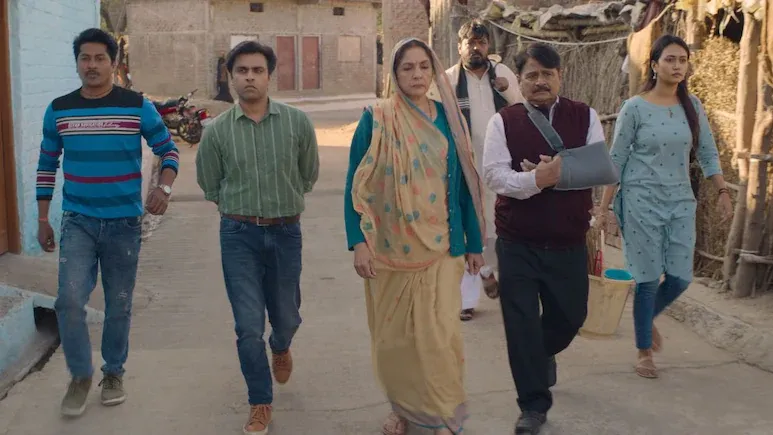
Season 4 of Panchayat returns to the dusty lanes of Phulera with escalating political tension, lingering grief, gentle humor, and deepening interpersonal drama. As the stakes rise ahead of the gram panchayat elections, the series explores murky local politics, shifting alliances, and simmering emotions beneath its rustic charm. While the humor that once defined the show now surfaces only sporadically, the narrative pivots toward realism, emotional heft, and the inevitable passage of change. With strong performances from an ensemble cast and a storyline that blends satire with sentiment, this season sets the tone for an intense Season 5.
A Shift in Tonal Terrain: Politics Gets Personal
“Politics is not child’s play,” mutters Brij Bhushan Dubey (Raghubir Yadav), better known in Phulera as the unofficial Pradhan. That line, dropped late in Season 4, sums up the overarching transformation of the series. What began as a light-hearted look at village bureaucracy is now a layered examination of ambition, corruption, ego, and emotional resilience.
Season 4 reflects this tonal shift. The stakes are higher, the laughs fewer, and the political drama more charged. With the gram panchayat elections approaching, alliances shift, and the idealism of early seasons gives way to power play and emotional compromise.
Fewer Laughs, Deeper Scars: A Different Kind of Humor
Gone are the frequent LOL moments from previous seasons, replaced by subtle, almost melancholic humor. A few sparks remain: a boozy text from Pradhan ji that leads to an impromptu men’s night, or a delightfully awkward moment when he addresses his father-in-law as “Aye sasur!” in his presence.
Prahlad (Faisal Malik), who still carries the emotional weight of losing his son at the border in Season 2, steals scenes with his restrained grief masked by gentle chuckles. His performance is poignant, serving as an emotional anchor for the series.
Laukis, Pressure Cookers, and Dirty Politics
The symbolism is delightfully absurd: Manju Devi’s lauki versus Kranti Devi’s pressure cooker. It’s more than a battle of vegetables—it’s a metaphor for an increasingly vicious electoral landscape. As gossip and smear campaigns heat up, food becomes a political tool, a cultural motif, and a unifying language.
One particularly nasty attack comes from Kranti Devi, whose false accusation against Khushboo (Vikas Shukla’s wife) stirs emotion and confrontation in the close-knit village. The fallout isn’t just personal—it sets the tone for just how ugly this election season could get.
Samosas, Laddoos, and the Flavor of Manipulation
Food is once again a storytelling device. When Manju Devi cleverly uses samosas to sway public opinion at a roadside tea stall, it’s more than political advertising—it’s a nostalgic callback to real-world Indian politics. There’s even a subtle nod to Lalu Prasad Yadav’s “samosa-aloo” symbolism.
The laddoos return as a not-so-subtle measure of electoral confidence. When one party orders 50 kg of desi ghee laddoos and the other settles for 25 kg made in vanaspati, it’s clear who believes they’re winning. It’s sharp, simple storytelling with deep cultural subtext.
Character Depth and Ensemble Evolution
Season 4 does justice to its secondary cast. Characters like Binod and Madhav, once relegated to comic relief, are now fully fleshed-out, engaging in the electoral chessboard with real stakes and subtle maneuvering. Manju Devi’s attempt to lure Binod away with sweet seviyan is both humorous and politically calculated.
Rinky (Sanvikaa), too, gets her moment. Her relationship with Abhishek (Jitendra Kumar) inches toward resolution, but ambition and pride loom large. The walk-and-talk moment where Abhishek contemplates quitting if Manju Devi loses—only to receive a cold stare from Rinky—suggests deeper personal reckonings on the horizon.
Love, Loss, and the Long Game
The much-anticipated romance between Abhishek and Rinky finally blooms, but not without complications. With Abhishek awaiting his CAT results, his future hangs in balance. The show poses a potent dilemma: should he stay for love and duty, or leave in pursuit of personal ambition?
Their story—like that of Phulera—is unfinished. The emotional resonance lies not in declarations but in silences, glances, and unresolved tension. Their fate, much like the village’s, is deferred to Season 5.
Final Thoughts: A Season of Setup and Substance
While Season 4 may lack the breezy charm of earlier installments, it compensates with character maturity, thoughtful writing, and a deeper exploration of power and purpose. For longtime fans, the show’s evolution is rewarding, though perhaps bittersweet. For new viewers, the season offers a rich, if slower, introduction to village life’s nuanced drama.
Abhishek’s friend sums it up in Episode 1: “Load mat le, sab theek ho jayega.” Perhaps that’s what the creators are signaling as they build toward what promises to be a climactic Season 5.
Cast:
Jitendra Kumar, Raghubir Yadav, Neena Gupta, Chandan Roy, Faisal Malik, Sanvikaa, Durgesh Kumar, Sunita Rajwar
Directors:
Deepak Kumar Mishra, Akshat Vijaywargiya
Comments