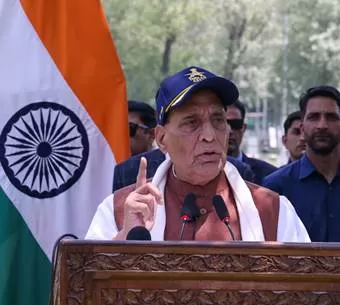
Defence Minister Rajnath Singh underscored Pakistan’s ongoing economic turmoil during an address to Army personnel in Srinagar, drawing a vivid contrast between India’s financial resilience and Pakistan’s dependence on international bailouts. Invoking a memorable line from Amitabh Bachchan’s film Kalia, Singh remarked that wherever Pakistan appears, a line of aid seekers invariably follows. This commentary spotlighted Pakistan’s recurring requests for International Monetary Fund (IMF) assistance, juxtaposed with India’s ascendant role as a creditor nation supporting global financial stability. The statement encapsulates the shifting economic dynamics in South Asia, reflecting India’s enhanced fiscal strength amid regional geopolitical challenges.
Contextualizing the Remarks
During a strategic engagement with the Indian Army in Srinagar, Defence Minister Rajnath Singh delivered pointed remarks highlighting Pakistan’s persistent economic fragility. Citing a famous cinematic dialogue, he quipped, “Pakistan jahaan khada hota hai, wahin se maangne waalon ki line shuru hoti hai,” encapsulating the narrative of Pakistan’s frequent recourse to external financial aid.
This metaphor served as a powerful rhetorical device to emphasize the contrast between the two neighboring countries, not just in terms of defense and diplomacy but also economic stability and sovereignty.
Pakistan’s Dependence on International Financial Aid
Pakistan’s fiscal landscape has been characterized by recurring balance-of-payments crises, compelling Islamabad to seek repeated IMF rescue packages. These bailouts reflect systemic vulnerabilities such as low foreign exchange reserves, high debt servicing burdens, and structural economic inefficiencies.
The country’s dependence on IMF support highlights ongoing challenges in macroeconomic management and reforms necessary to stabilize growth and restore investor confidence. Such recurring financial distress has wide-ranging implications for Pakistan’s socio-political stability and regional security dynamics.
India’s Emergence as a Global Financial Player
In stark contrast, India’s economy has demonstrated significant resilience and growth, transitioning from an IMF borrower in the 1990s to a global economic power capable of extending financial assistance. India’s recent role as a lender to the IMF underscores its expanding fiscal space and strengthened foreign exchange reserves.
This evolution marks India’s enhanced credibility on the global stage, positioning it as a pivotal player in multilateral financial institutions and a contributor to global economic stability. It also reflects prudent macroeconomic policies, diversified growth drivers, and a large domestic market that collectively underpin India’s economic ascent.
Broader Implications for South Asia
Minister Singh’s remarks go beyond mere political rhetoric; they encapsulate broader regional economic divergences that influence strategic calculations. Pakistan’s economic vulnerabilities impact its internal stability and foreign policy postures, while India’s growing financial clout provides it with leverage in shaping regional and global economic agendas.
This contrast is emblematic of the shifting power dynamics in South Asia, where economic strength increasingly translates into geopolitical influence and soft power.
Conclusion
Rajnath Singh’s evocative invocation of a cinematic line to describe Pakistan’s economic plight poignantly captures the stark realities facing South Asia’s two nuclear-armed neighbors. As Pakistan continues to grapple with financial instability, India’s rise as a lender and regional economic powerhouse heralds a new chapter in the subcontinent’s economic and strategic narrative. This development invites policymakers, analysts, and investors to closely monitor the evolving interplay of economic and security factors shaping South Asia’s future.
Comments