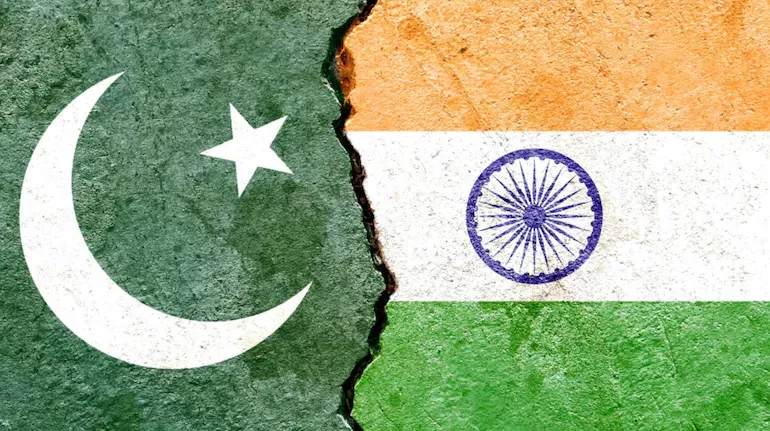
Amid escalating geopolitical tensions between India and Pakistan, investor anxiety has cast a spotlight on the vast disparity between the two nations’ capital markets. While India’s stock market stands among the world’s top five by market capitalization, Pakistan’s is a fraction of the size, plagued by volatility and structural fragility. With trading temporarily suspended on the Pakistan Stock Exchange after a steep selloff, comparisons with India's financial ecosystem underscore just how far apart the two economies stand — not just in scale, but also in corporate profitability, stability, and long-term resilience.
Market Capitalization: A Chasm in Scale
India’s equity market boasts a staggering market capitalization of $4.24 trillion, placing it in the upper echelons of global financial markets. By contrast, Pakistan’s entire stock market is valued at just $44.06 billion — roughly 1% of India's total. This stark divergence becomes even more pronounced when examining the size of individual companies.
The largest publicly listed entity in Pakistan, Oil & Gas Development Company Limited, has a market cap of $2.74 billion. In the Indian context, it would barely scrape into the top 300, ranking approximately 280th. In fact, only nine Pakistani firms have market capitalizations exceeding $1 billion, compared to over 550 Indian companies that have crossed that threshold.
India’s five largest firms — Reliance Industries, HDFC Bank, TCS, Bharti Airtel, and ICICI Bank — each command valuations north of $100 billion. Even IndusInd Bank, the smallest member of India’s benchmark Sensex index, carries a valuation of approximately $7.5 billion, far surpassing all but the top few Pakistani companies.
Profitability Gap: Indian Giants Dwarf Regional Peers
Corporate earnings further highlight the imbalance. Nearly 20 Indian companies reported annual net profits of over $1 billion each in the trailing 12-month period. Market titans such as the State Bank of India, HDFC Bank, and Reliance Industries earned between $8 and $10 billion individually — dwarfing the performance of their Pakistani counterparts.
In stark contrast, Pakistan’s largest listed firm, Oil & Gas Development Company, posted a net profit of around $740 million. The average annual net profit for Pakistan’s top 20 companies is just $200 million. In India, that average is roughly $3.4 billion — more than 17 times greater.
These figures reflect not only superior scale, but also stronger operational efficiency, better governance frameworks, and deeper access to capital for Indian firms.
Volatility and Investor Sentiment
Recent market activity has thrown Pakistan’s structural vulnerabilities into sharp relief. Following heightened regional tensions and the launch of India’s Operation Sindoor, the KSE-100 — Pakistan’s primary benchmark index — tumbled over 6% in intra-day trading on May 8. Despite a partial recovery, the index ended the session down 3%.
The following day saw even greater panic. Trading on the Pakistan Stock Exchange was halted temporarily after the index plunged more than 7,300 points — over 7% of its value — within hours.
By contrast, India’s BSE Sensex remained comparatively stable, shedding just 100 points on the first day and about 400 points the day after, amid broader regional and global market volatility. The muted reaction signaled investor confidence in the underlying fundamentals of India’s economy.
Historical Returns: Momentum Versus Fundamentals
In 2024 and 2023, Pakistan’s KSE-100 posted impressive gains of 84% and 54.33%, respectively — outpacing the Sensex’s 8.17% and 18.74% returns in those years. However, these short-term surges are largely seen as rebounds from previous lows and driven by temporary monetary or fiscal policy interventions.
From 2017 through 2022, India consistently outperformed Pakistan in annual market returns, bolstered by robust corporate earnings, consistent regulatory reform, and sustained foreign inflows. This long-term outperformance suggests a structurally superior market rather than one merely buoyed by opportunistic cycles.
As of the current year-to-date, the Sensex is up 3.40%, while the KSE-100 is down over 6%, reintroducing the pattern of Indian dominance in market stability and returns.
China Comparison: Scale Is Not Everything
India's stock market is still smaller than China’s, which has a market capitalization of $10.25 trillion. Yet when comparing individual company sizes, the disparity is surprisingly narrow. Only four Chinese companies — Industrial & Commercial Bank of China, Kweichow Moutai, Agricultural Bank of China, and China Mobile — are larger than Reliance Industries, India’s most valuable company.
This parity at the corporate level points to the growing global relevance of Indian firms, especially as China grapples with regulatory tightening and slowing growth.
Conclusion: Structural Strength Over Short-Term Surges
The widening gulf between India and Pakistan’s stock markets is more than a matter of size. It reflects deeper economic fundamentals, institutional strength, and corporate maturity. While short bursts of momentum may temporarily lift weaker markets, long-term investor confidence is built on resilience, governance, and sustainable profitability — traits that India’s capital markets increasingly embody.
As geopolitical events unfold, the contrast in market behavior reinforces a simple truth: in global investing, structural strength wins the long game.
Comments