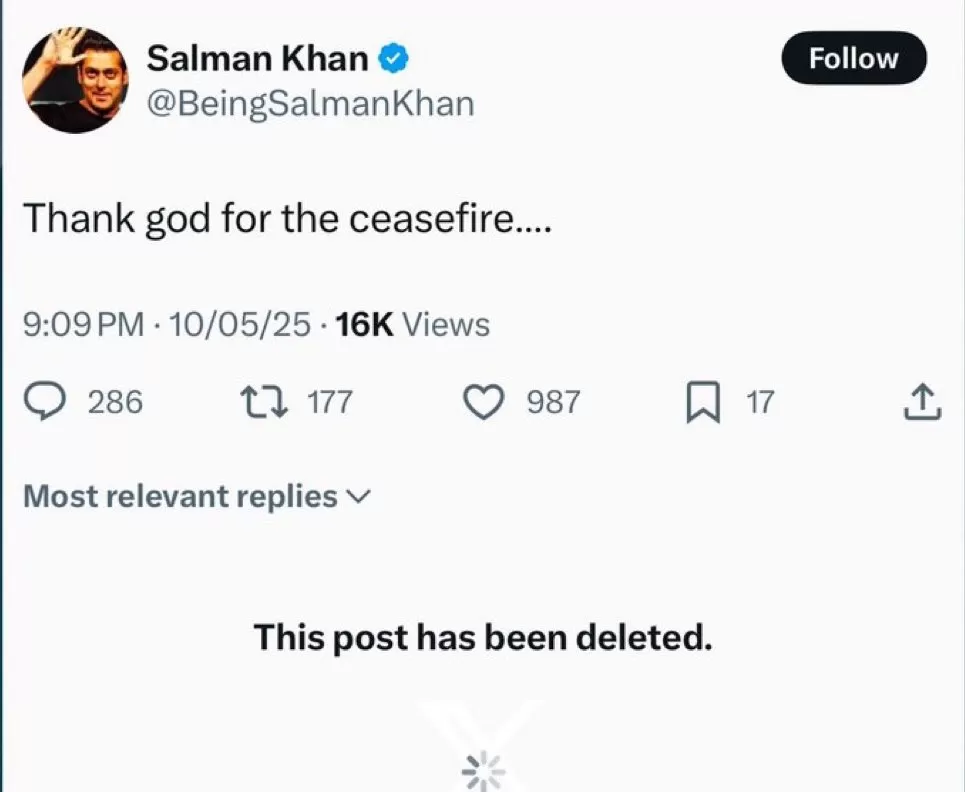
Bollywood superstar Salman Khan found himself at the center of a social media storm after posting — and swiftly deleting — a tweet expressing relief over the ceasefire agreement between India and Pakistan. The controversy erupted in the aftermath of India’s military response to the deadly Pahalgam terror attack through Operation Sindoor. Netizens condemned Khan for overlooking the sacrifices of Indian soldiers and victims of terror, accusing him of tone-deafness at a moment of national mourning. The episode reignited a larger debate about the responsibilities of public figures in times of national crisis.
A Ceasefire and a Controversy
On the heels of heightened tensions between India and Pakistan, both countries agreed to a ceasefire following a series of intense military exchanges. India's Operation Sindoor — a retaliatory strike in response to the April 22 Pahalgam terror attack that left several dead — had significantly degraded Pakistan’s strategic airbases and terror infrastructure.
As news of the ceasefire broke, actor Salman Khan posted a brief message on X (formerly Twitter): “Thank God for the ceasefire…” The seemingly innocuous statement quickly spiraled into a digital firestorm, triggering outrage across the Indian social media landscape.
Critics accused Khan of prioritizing peace overtures over acknowledging the brutal terrorist assault on Indian soil, the loss of civilian lives, and the valiant efforts of the Indian Armed Forces. The fact that the actor had remained publicly silent on the Pahalgam attack while swiftly responding to the ceasefire struck many as insensitive and politically tone-deaf.
Public Backlash and the Fallout
The criticism was swift and unrelenting. Many users interpreted Khan’s tweet as being sympathetic to Pakistan, or at the very least, apathetic to Indian sentiment. Screenshots of the now-deleted post continued to circulate online, fueling further anger.
“Salman Khan deleted his tweet, made no posts about Pahalgam, while Shah Rukh Khan and Aamir Khan also stayed silent during the terrorist attack on India,” one tweet read. Another user wrote, “India should boycott Salman Khan.” Comments ranged from disappointment to calls for action, with several users accusing him of “selective silence” and failing to express solidarity with India during a moment of national grief.
The backlash underscores a broader concern among citizens — that celebrities, while free to voice their opinions, bear a certain moral and social responsibility, particularly in moments of national tragedy.
Operation Sindoor and Strategic Gains
India’s military response, dubbed Operation Sindoor, had a clear objective: neutralize terror camps and dismantle Pakistan’s cross-border threat capabilities. Over several days, India launched a combination of artillery, drone, and missile strikes aimed at Pakistani infrastructure and military assets. The campaign culminated in decisive final blows to key Pakistani airbases, significantly impairing its aerial defense capabilities.
It was only after these sustained strikes that Pakistan’s Director General of Military Operations (DGMO) reached out to his Indian counterpart, initiating talks that eventually led to the ceasefire agreement.
While the ceasefire may have brought a temporary halt to hostilities, the geopolitical implications remain tense, and public sentiment is still heavily weighted by the scars of the Pahalgam tragedy.
Celebrity Silence: A Double-Edged Sword
This episode isn’t the first time celebrities have faced scrutiny for their political silence or perceived detachment during national crises. However, the scale and sensitivity of the Pahalgam attack amplified expectations from public figures to show moral clarity. For fans and citizens alike, silence from influential voices can often be construed as indifference — or worse, complicity.
The expectation isn’t necessarily political commentary but emotional resonance — a simple act of solidarity or acknowledgment that can help unify the national psyche. In this context, Salman Khan’s silence on the terror attack juxtaposed with his relief over the ceasefire felt jarring to many.
As of this writing, Khan has not issued a clarification or replacement statement — a conspicuous silence that continues to fuel speculation and disappointment.
Conclusion: The Weight of Public Words
In an era where every statement from a public figure is dissected in real-time, the line between freedom of expression and public accountability is increasingly thin. Salman Khan’s deleted tweet serves as a cautionary tale for celebrities navigating national tragedies: timing and tone matter, and silence — when not paired with empathy — can be louder than words.
The larger question lingers: Should celebrities speak up in times of national crisis, or does their silence reflect a desire to remain apolitical? The public, it seems, has already answered.
Comments