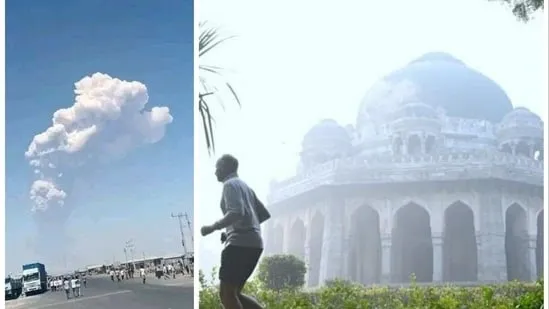
Delhi residents woke up to a ‘very poor’ air quality index (AQI) today, raising health concerns across the capital. Environmental authorities attribute the deterioration primarily to local emissions from traffic and industrial activity, compounded by meteorological conditions. Additionally, experts have highlighted potential contributions from volcanic ash originating from recent eruptions in Ethiopia, which may have traveled across long distances. The combined impact has led to heightened warnings for vulnerable populations, including children, the elderly, and those with respiratory conditions. Authorities have urged citizens to minimize outdoor exposure, wear masks, and follow air quality advisories while monitoring potential environmental and health repercussions.
Current Air Quality Status
Delhi’s AQI has been classified as ‘very poor,’ indicating severe levels of pollutants such as PM2.5 and PM10. These fine particulate matters pose significant respiratory and cardiovascular risks, prompting advisories for residents to limit outdoor activities and adopt protective measures. Air monitoring stations across the city report sustained concentrations well above permissible limits, underscoring the seriousness of the situation.
Potential Impact of Ethiopian Volcanic Ash
Volcanologists suggest that volcanic ash from recent eruptions in Ethiopia may have traveled across the atmosphere and contributed marginally to Delhi’s particulate matter levels. While the primary sources remain local, the long-range transport of ash particles can exacerbate existing air quality challenges, particularly when combined with urban pollution. Such occurrences highlight the global interconnectedness of environmental phenomena.
Health Advisory and Public Precautions
Authorities have issued health advisories, emphasizing the need for masks, indoor air purifiers, and limited outdoor activity. Vulnerable groups—children, the elderly, and those with pre-existing respiratory or cardiovascular conditions—have been specifically cautioned. Public health experts recommend increased hydration, avoidance of strenuous outdoor exercise, and monitoring for symptoms such as coughing, wheezing, and shortness of breath.
Mitigation Measures and Government Response
The Delhi Pollution Control Committee (DPCC) and related agencies are monitoring air quality in real time and coordinating with traffic and industrial authorities to reduce emissions. Steps include regulating construction dust, minimizing vehicular emissions, and controlling open burning. Public advisories are being disseminated through multiple channels to ensure awareness and compliance.
Conclusion
Delhi’s ‘very poor’ air quality underscores the complex interplay of local pollution and global environmental factors, such as volcanic ash from distant regions. Vigilant monitoring, adherence to health advisories, and coordinated mitigation strategies are essential to safeguard public health and address environmental challenges in one of India’s most densely populated capitals.
Comments