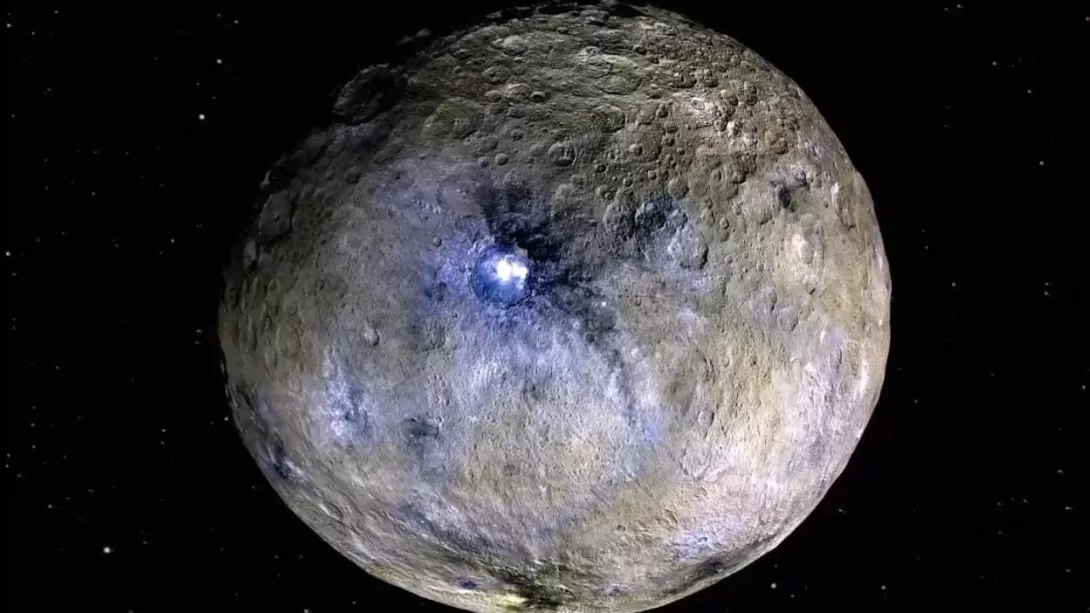
Astronomers have identified a previously unknown icy object, designated 2017 OF201, situated at the farthest reaches of our solar system. This celestial body, potentially a dwarf planet roughly 700 kilometers in diameter, exhibits an extraordinarily elongated orbit that spans 25,000 Earth years, far exceeding Pluto’s 248-year orbit. Its discovery, made through meticulous analysis of archival telescope data, complicates existing models of the solar system’s architecture and casts doubt on the hypothesized “Planet 9.” The finding underscores the vast, still largely uncharted expanse of our cosmic neighborhood, prompting a re-examination of planetary formation and orbital dynamics in the distant solar periphery.
A New Frontier Beyond Pluto
The announcement of 2017 OF201 has sent ripples through the astronomical community, marking one of the most significant solar system discoveries in recent years. Orbiting at distances ranging from 44.5 to over 1,600 times the Earth-Sun separation (astronomical units), this remote object pushes the boundaries of known planetary bodies far beyond the familiar Kuiper Belt. Unlike Pluto’s relatively compact orbit, 2017 OF201 traces a highly eccentric path around the Sun, requiring approximately 25 millennia to complete one revolution.
The object’s vast orbit raises profound questions about its origin and the gravitational forces that have shaped its trajectory. It may have been displaced through gravitational interactions with giant planets such as Jupiter or Neptune, or perhaps it was once ejected into the hypothesized Oort Cloud—a vast, spherical reservoir of icy bodies encasing the solar system—before returning to its present orbit.
Implications for Solar System Architecture
Measuring approximately 700 kilometers in diameter (435 miles), 2017 OF201 fits the criteria for classification as a dwarf planet, sharing this status with Pluto since its reclassification in 2006. Its discovery is part of an ongoing effort led by Sihao Cheng of the Institute for Advanced Study and his Princeton collaborators, who analyzed extensive archival data from the Victor M. Blanco Telescope in Chile and the Canada France Hawaii Telescope.
The search aimed to detect evidence of “Planet 9,” a hypothetical massive body believed to influence the orbital patterns of extreme trans-Neptunian objects (TNOs). However, 2017 OF201’s orbit deviates significantly from the clustering pattern expected if Planet 9 exerted gravitational control on distant bodies, thereby challenging the planet’s existence.
A Breakthrough in Astronomical Methodology
This discovery highlights the power of modern computational techniques applied to historical astronomical data. By employing sophisticated algorithms, the research team tracked slow-moving bright points across years of sky images, leading to the identification of this remote world. Such methods exemplify a paradigm shift in celestial discovery, where digital mining of vast data sets complements traditional telescope observations.
Despite technological advances enabling deep space exploration, the discovery of 2017 OF201 illustrates that our immediate cosmic vicinity still holds many secrets. As Cheng notes, the solar system remains ripe for revelations that could reshape our understanding of planetary formation and migration processes.
Rethinking the Outer Solar System
The identification of 2017 OF201 not only extends the catalog of known distant bodies but also prompts a reassessment of the solar system’s outermost regions. The object’s atypical orbit undermines the presumed gravitational influence of Planet 9, a theory that has gained traction as an explanation for observed anomalies in trans-Neptunian orbits.
As Jiaxuan Li, a collaborator on the project, has articulated, the peculiarities of 2017 OF201 may indicate that the elusive Planet 9 does not exist, reshaping ongoing debates in planetary science. The team’s findings have been made publicly available on the arXiv pre-print server, inviting further scrutiny and discussion within the scientific community.
Conclusion
The discovery of 2017 OF201 opens a compelling new chapter in our exploration of the solar system’s frontier. It underscores the dynamic and evolving nature of planetary science, where each new object challenges preconceived notions and expands our cosmic perspective. As astronomers continue to unravel the mysteries beyond Neptune, such findings not only enrich our scientific understanding but also inspire renewed curiosity about the vastness and complexity of the universe we inhabit.
Comments