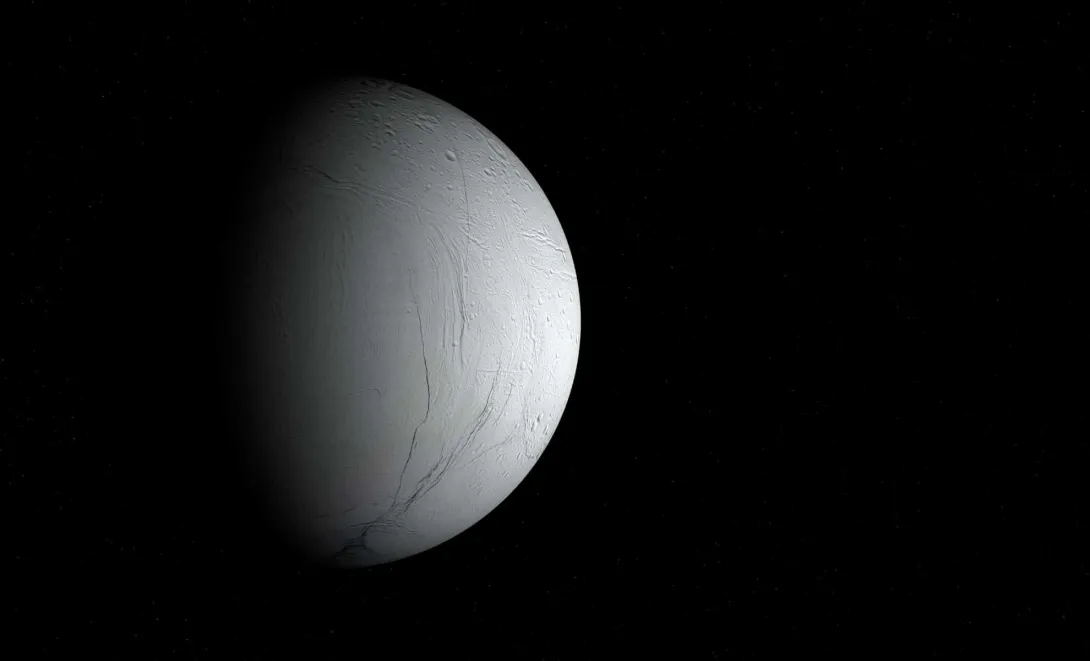
NASA's Cassini mission has unveiled compelling evidence of complex organic molecules in the plumes of Saturn's moon Enceladus, suggesting that this icy moon harbors the essential ingredients for life. These findings, derived from data collected between 2005 and 2015, indicate that Enceladus' subsurface ocean contains a rich array of organic compounds, including those fundamental to amino acid formation. This discovery positions Enceladus as a prime candidate in the search for extraterrestrial life within our solar system.
Enceladus: A Potential Cradle for Life
Enceladus, one of Saturn's moons, has long intrigued scientists due to its subsurface ocean and active geysers. The Cassini spacecraft's close flybys revealed that these geysers eject water vapor, ice particles, and organic molecules into space, providing a unique opportunity to study the moon's internal composition without landing. The detection of complex organic molecules in these plumes suggests that Enceladus possesses the chemical building blocks necessary for life.
Organic Molecules: Indicators of Habitability
The presence of organic compounds in Enceladus' plumes is significant. These molecules, which include carbon, nitrogen, and oxygen, are fundamental to life as we know it. Their detection implies that Enceladus' oceanic environment may be chemically rich and potentially habitable. This finding aligns with previous discoveries of hydrothermal activity beneath the moon's icy crust, suggesting that energy sources conducive to life could exist in this alien ocean.
Implications for Astrobiology
The discovery of complex organic molecules in Enceladus' plumes has profound implications for astrobiology. It supports the hypothesis that life could arise in environments vastly different from Earth, broadening the scope of habitable zones in the universe. Enceladus, with its combination of organic chemistry, water, and energy sources, presents a compelling case for the existence of extraterrestrial life.
Conclusion
NASA's Cassini mission has provided groundbreaking insights into the potential for life on Enceladus. The detection of complex organic molecules in its plumes underscores the moon's capacity to support life. As we continue to explore Enceladus and other celestial bodies, these findings inspire further investigation into the origins and distribution of life in the cosmos.
Comments