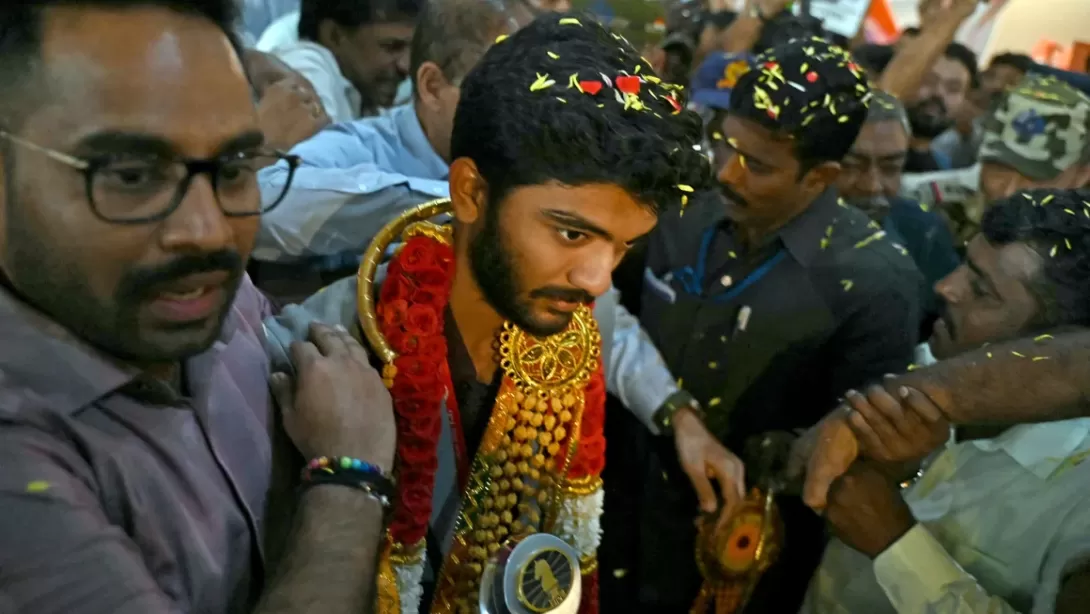
In a landmark moment for global chess and Indian sport, 18-year-old Gukesh Dommaraju has become the youngest-ever World Chess Champion, defeating defending titleholder Ding Liren of China in a tense final match held in Singapore. With a score of 7.5–6.5, Gukesh surpassed Garry Kasparov’s long-standing record, previously set at age 22 in 1985. Upon his triumphant return to Chennai, the teenage grandmaster received a hero’s welcome—one more akin to a national sports icon than a traditional chess player. His victory not only symbolizes a generational shift in the sport but also reaffirms India’s growing dominance on the global chessboard.
A New Crown in Indian Chess History
Gukesh Dommaraju’s stunning victory marks only the second time an Indian player has secured the FIDE World Championship title, following in the footsteps of the legendary Viswanathan Anand, a five-time world champion also hailing from Chennai. While Anand’s reign once symbolized the emergence of Indian talent on the world stage, Gukesh’s ascent signals a full generational shift. At just 18, his rise reflects years of disciplined preparation and the maturing ecosystem of chess in India.
His victory in the best-of-14 match series came down to a dramatic final game, during which Ding Liren, the incumbent champion, blundered under pressure—an unforced error that sealed the fate of the match. Gukesh held his composure and capitalized to claim the crown with a 7.5–6.5 score.
A Hero’s Welcome in Chennai
The magnitude of Gukesh’s achievement was matched by the reception he received upon his return to India. Landing at Chennai International Airport on Monday, the young champion was met by an exuberant crowd of fans, local officials, and media. Amid confetti, patriotic chants, and banners praising “The new king in the kingdom of chess,” Gukesh emerged draped in the Indian tricolor, visibly moved by the overwhelming support.
His arrival scene echoed those typically reserved for cricket superstars or film icons—a telling sign of how deeply his achievement resonated with the public. From men on stilts to a specially designed vehicle emblazoned with celebratory slogans, the celebrations underscored the cultural and national importance of his win.
Setting a New Benchmark in Global Chess
By clinching the world title at just 18, Gukesh not only broke Garry Kasparov’s 39-year-old record but also demonstrated a seismic shift in how chess is evolving. Today’s players, increasingly nurtured through digital tools, advanced analytics, and international exposure, are achieving elite status earlier than ever before. Gukesh’s win reflects this trend, but also highlights the mental fortitude, maturity, and strategic depth required to navigate the rigorous demands of a world championship match.
His victory also deepens the narrative of India’s ascent in global intellectual sports. With a generation of young grandmasters rising—many of whom cite Anand as their inspiration—India is no longer a peripheral force but a central player in the chess world.
From Victory to Diplomacy: A National Figure Emerges
Indian Prime Minister Narendra Modi was among the first to publicly congratulate Gukesh, describing his win as both “historic and exemplary.” The grandmaster is expected to meet with Modi later this month, adding a diplomatic layer to his rising profile. The meeting would not only recognize Gukesh’s individual success but may also reflect broader governmental interest in fostering strategic, high-IQ sports among the youth.
This evolving attention—from media to the political establishment—suggests Gukesh is not merely a fleeting sports headline, but a symbol of national aspiration and intellectual capability.
Conclusion: A Prodigy Redefining Possibility
Gukesh Dommaraju’s triumph at the 2024 FIDE World Chess Championship is a victory that transcends sport. It’s a story of resilience, youth, and national pride; a reminder that excellence can emerge not just from legacy institutions, but also from local passion, mentorship, and unyielding commitment. As the chess world recalibrates in response to this new champion, India stands at the forefront—both as a talent factory and as a nation reinvigorating global chess with fresh dynamism and promise.
Comments