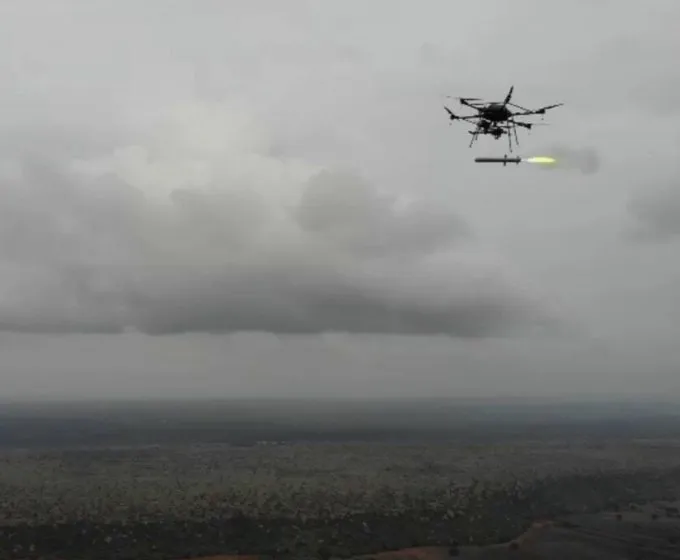
India has marked a significant milestone in its defense capabilities by successfully test-firing a missile from an unmanned aerial vehicle (UAV). This technological advancement signals a strategic leap in modern warfare and positions India alongside a select group of nations with integrated drone-based offensive systems. The successful launch, conducted under controlled conditions, enhances the Indian Armed Forces' ability to execute precision strikes without risking human lives, a key priority in today’s combat environments. This development is part of India’s broader efforts to modernize its defense infrastructure through indigenous innovation and tactical autonomy.
---
Strategic Importance of the Missile-Drone Integration
In an era where air dominance is increasingly defined by precision and automation, India's ability to integrate missiles with unmanned platforms reflects a future-ready military doctrine. The drone-launched missile capability dramatically increases the reach, agility, and stealth of India’s armed forces, particularly in hostile or inaccessible environments.
Unlike traditional fighter jets or manned attack helicopters, combat drones equipped with missile systems can loiter for extended durations, scan vast territories, and strike high-value targets with minimal delay and no onboard crew risk. This technology is not merely tactical—it is transformational.
---
Indigenous Innovation at the Forefront
The test underscores India's commitment to self-reliance in defense manufacturing, a cornerstone of the 'Atmanirbhar Bharat' initiative. Developed through collaboration between key defense agencies and domestic aerospace firms, the drone-missile system combines advanced guidance, surveillance, and propulsion technologies.
Defense analysts note that the operational success of this weaponized UAV demonstrates robust design, payload adaptability, and target accuracy—qualities that were once dominated by a few military powers. India’s entry into this space signals a departure from dependency on foreign suppliers for next-gen military hardware.
---
Tactical Implications for Regional Security
India's geographic proximity to volatile borders makes aerial superiority a strategic imperative. The deployment of drones capable of launching missiles from afar reduces the need for forward deployment of troops and assets. In the context of asymmetric warfare, insurgent threats, or cross-border tensions, such systems could provide a decisive advantage.
Moreover, the psychological impact of unmanned precision strikes serves as a strong deterrent, reinforcing India’s defensive posture while preserving its doctrine of strategic restraint.
---
Toward a New Era of Autonomous Defense Systems
This breakthrough aligns with global trends toward increased automation in defense—ranging from AI-powered reconnaissance to autonomous combat units. While ethical and command-control considerations remain under global debate, the operational efficiency of drone-based missile delivery is undeniable.
By incorporating such technologies into its military doctrine, India is not only addressing present challenges but also future-proofing its defense capabilities in a rapidly evolving security landscape.
---
Conclusion:
The successful launch of a missile from an unmanned drone represents more than just a technological win—it’s a paradigm shift for India’s defense strategy. As the nation continues to invest in indigenous innovation and battlefield automation, the lines between manned and unmanned warfare will blur, redefining how India protects its sovereignty in the 21st century.
Comments