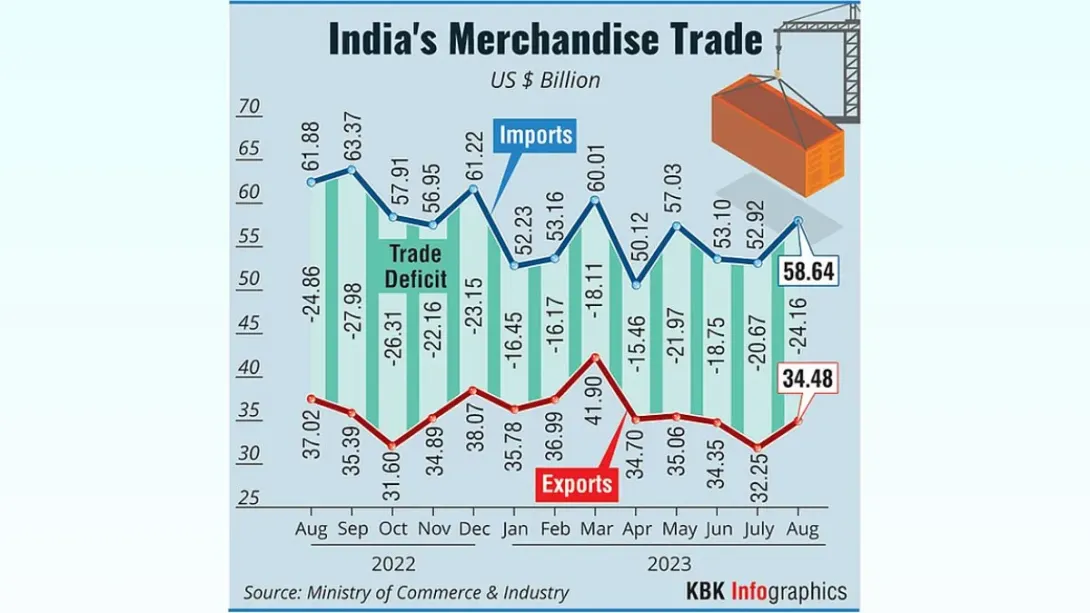
India’s merchandise and services exports are projected to climb to $850 billion by FY26, reflecting strengthening global integration and sustained policy support, according to estimates by the Global Trade Research Initiative. The forecast underscores India’s expanding role in international supply chains, supported by manufacturing incentives, services-led growth and market diversification. While global trade remains exposed to geopolitical and economic uncertainties, India’s export outlook is being buoyed by resilience in services, steady gains in engineering goods and improved trade facilitation. For policymakers and businesses, the projection highlights both opportunity and the need for continued structural reform.
Drivers Behind the Export Growth Outlook
The projected rise in exports is anchored in a combination of structural and cyclical factors. Manufacturing incentives under production-linked schemes have improved competitiveness in sectors such as electronics, pharmaceuticals and engineering goods. At the same time, services exports—particularly information technology, business services and digital solutions—continue to deliver consistent growth.
Trade experts note that India has made measurable progress in diversifying export markets, reducing over-reliance on a few geographies and expanding engagement with emerging economies.
Services Exports Remain a Key Pillar
Services are expected to account for a substantial share of export growth through FY26. Demand for Indian IT and digital services remains robust, driven by global enterprises seeking cost efficiency and digital transformation. Professional services, consulting and knowledge-based exports are also gaining traction.
This resilience in services provides a stabilizing counterweight to volatility in merchandise trade, especially during periods of global demand uncertainty.
Merchandise Exports and Manufacturing Push
On the goods side, engineering products, chemicals, pharmaceuticals and electronics are expected to lead expansion. Investments in manufacturing capacity and supply-chain integration are helping Indian exporters improve scale and quality.
However, analysts caution that competitiveness will depend on continued improvements in logistics, energy costs and regulatory efficiency. Exchange rate stability and access to affordable trade finance will also play an important role in sustaining momentum.
Global Risks and Policy Imperatives
Despite the optimistic outlook, external risks remain. Geopolitical tensions, protectionist policies and slowing growth in major economies could affect trade flows. Exporters will need to remain agile, adapting to shifting demand patterns and compliance requirements.
Policy continuity, trade agreements and infrastructure investment will be critical in translating projections into reality. Simplifying customs processes and enhancing port efficiency are seen as immediate priorities.
A Strategic Milestone in India’s Trade Ambition
Reaching $850 billion in exports by FY26 would mark a significant milestone in India’s economic trajectory. Beyond the headline number, the projection reflects deeper structural changes in how India engages with global markets.
For businesses, the outlook reinforces the case for capacity expansion and market diversification. For policymakers, it underscores the importance of sustaining reforms that strengthen competitiveness. If momentum is maintained, India’s export sector could emerge as a more powerful engine of growth in the years ahead.
Comments