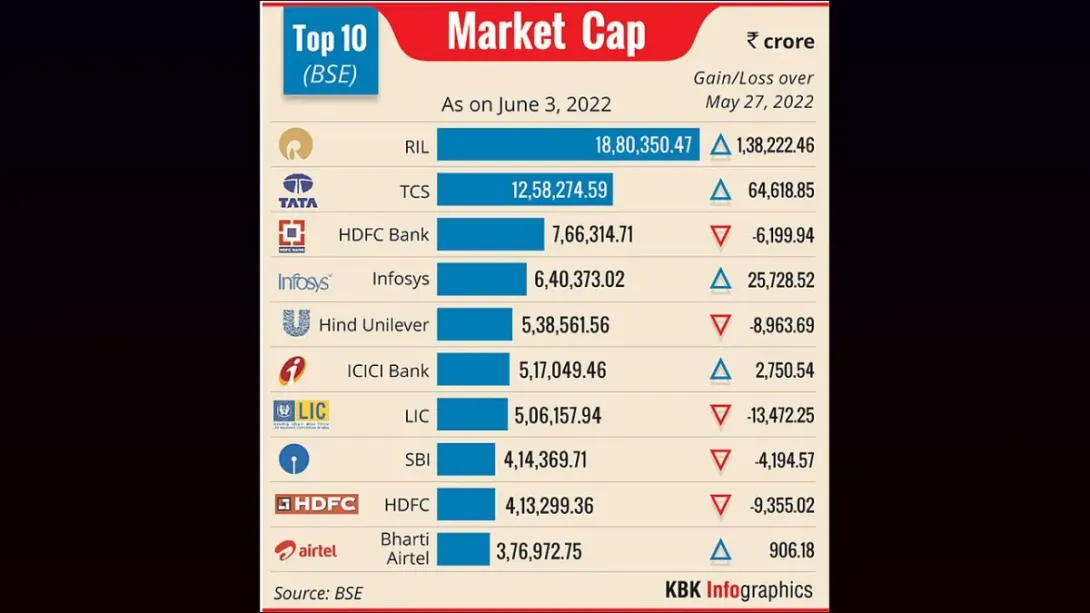
Indian equity markets witnessed a notable erosion in investor wealth as several frontline companies collectively shed Rs. 35,439 crore in market capitalization during the latest trading phase. The decline reflects a cautious investor mood driven by global uncertainty, profit-booking and sector-specific pressures. State Bank of India (SBI), the country’s largest lender, emerged as the most significant laggard, underperforming peers amid concerns over margins and broader banking sector dynamics. While the broader market showed resilience in pockets, the setback among heavyweight stocks underscores the fragility of sentiment and the growing divergence in stock-specific performance.
Sharp Decline in Market Capitalization
A group of leading Indian companies saw their combined market capitalization fall by Rs. 35,439 crore, marking a challenging session for benchmark indices. The decline was concentrated among select large-cap stocks, which traditionally anchor market stability. Analysts attributed the slide to a mix of global risk aversion, muted institutional inflows and stock-specific triggers that prompted investors to trim exposure.
Despite steady domestic participation, the selling pressure in heavyweight counters weighed on overall valuations, highlighting the outsized influence of blue-chip stocks on market direction.
SBI Underperforms Banking Peers
State Bank of India stood out as the weakest performer among major firms, recording a significant drop in market value. Market participants cited concerns around net interest margin sustainability, rising competition in retail lending and cautious guidance as factors dampening sentiment toward the stock.
While the banking sector remains structurally strong, investors appear increasingly selective, favoring private lenders and non-banking financial companies with faster growth visibility. SBI’s underperformance illustrates how even fundamentally strong institutions are not immune to short-term market recalibration.
Sectoral and Stock-Specific Pressures
Beyond banking, selective weakness was observed across sectors such as information technology and metals, where global cues played a decisive role. Uncertainty around interest rate trajectories in developed markets and slowing demand outlooks added to volatility.
Market strategists noted that the recent decline does not signal a broad-based correction but rather reflects rotation and consolidation after a sustained rally. Stocks with stretched valuations or near-term earnings headwinds bore the brunt of the sell-off.
Investor Outlook and Market Implications
From a broader perspective, the erosion of Rs. 35,439 crore in market capitalization serves as a reminder of the market’s sensitivity to both domestic fundamentals and global developments. Experts advise investors to focus on balance sheet strength, earnings visibility and long-term growth drivers rather than short-term price movements.
As volatility persists, the ability of large-cap companies to deliver consistent performance will remain central to restoring confidence and stabilizing market sentiment in the weeks ahead.
Comments