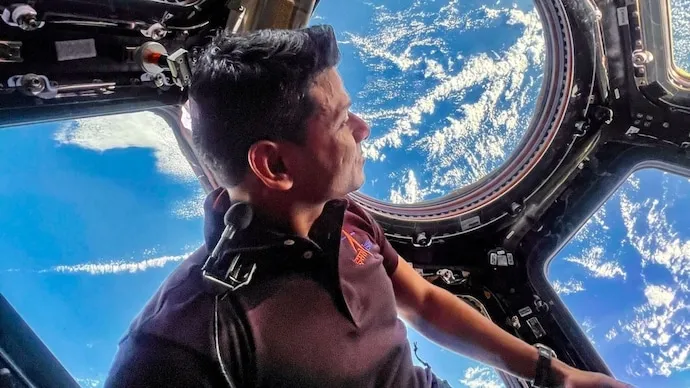
Space exploration has always fascinated young minds, but few truly understand the everyday challenges astronauts face beyond Earth’s atmosphere. In an engaging session with Indian students, astronaut Shux shed light on a question that often sparks curiosity: how do astronauts sleep when orbiting the planet at breakneck speeds and witnessing multiple sunrises and sunsets in a single day?
The Challenge of Sleeping in Orbit
Unlike life on Earth, astronauts aboard the International Space Station experience nearly 16 sunrises and sunsets every 24 hours. This constant shift between light and darkness can be extremely confusing for the human body clock. Shux explained that the concept of day and night in orbit is purely artificial — governed by schedules rather than natural sunlight. “We don’t follow the sun,” Shux remarked, highlighting how astronauts rely on carefully planned routines to maintain a healthy sleep cycle.
How Astronauts Manage Their Sleep
To simulate a normal Earth-like day, astronauts adhere to strict timetables. Shux described how each crew member is assigned about eight hours of sleep per ‘day,’ enforced through dimmed lights and closed sleeping quarters to block out the changing light. They sleep in small cabins or zip themselves into sleeping bags attached to the walls to prevent floating around in microgravity. This controlled environment allows them to get adequate rest despite the unusual external conditions.
The Role of Mental Discipline
Beyond the physical setup, astronauts need strong mental discipline to adjust to these unconventional sleeping patterns. Shux told the students that it’s crucial to stick to the schedule regardless of whether one feels tired or alert, to keep their biological clocks aligned. This discipline ensures they are fully functional for demanding tasks like spacewalks, experiments, and maintaining the station’s systems.
A Lesson for Young Dreamers
In conclusion, Shux’s interaction served as more than just a science lesson; it offered a glimpse into the resilience and adaptability required of space explorers. For Indian students aspiring to careers in space, the astronaut’s words underscored an important reality: life in orbit demands not only technical skills but also the ability to adapt your body and mind to an environment that is entirely detached from Earth’s natural rhythms.
Comments