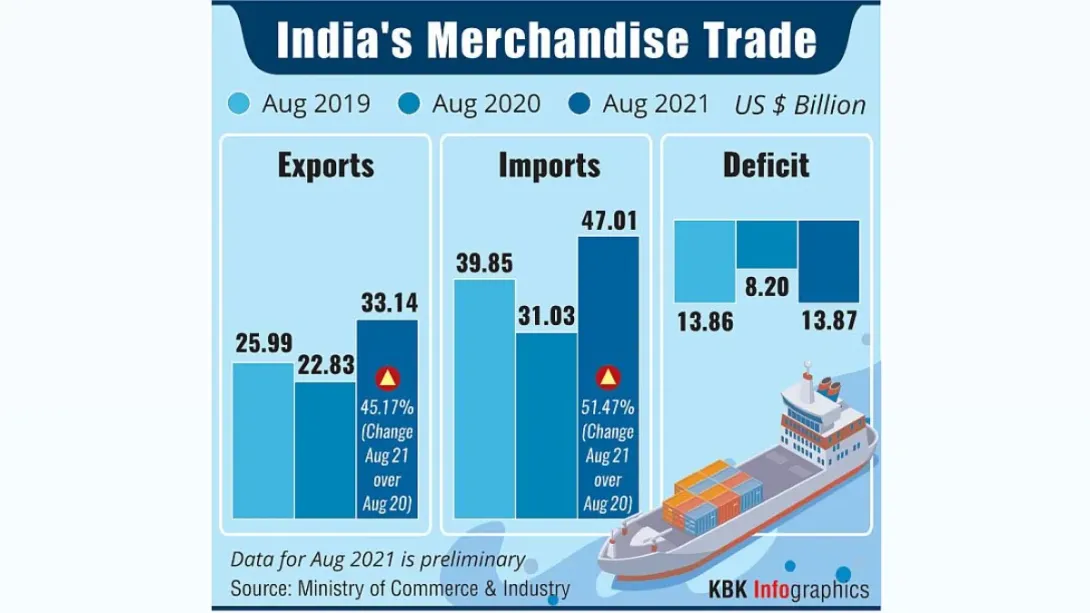
India’s merchandise exports rose 6.7% in August compared with the same month last year, reflecting resilient global demand and the country’s export diversification efforts. At the same time, imports declined, contributing to a favorable impact on the trade balance. Key export segments such as petroleum products, engineering goods, and pharmaceuticals drove growth, while a slowdown in gold, electronics, and crude imports moderated inbound trade. Analysts highlight that India’s export-oriented policies, currency stability, and targeted sectoral incentives are supporting external trade. The data underscores India’s improving external sector performance amid global economic uncertainties.
---
Export Performance Overview
According to trade data, India’s exports in August recorded a 6.7% year-on-year increase. Growth was led by:
Petroleum Products: Benefiting from global energy demand.
Engineering Goods: Including machinery, automobiles, and components.
Pharmaceuticals: Driven by rising demand in global markets.
Gems and Jewellery: Contributing modestly despite global economic headwinds.
This performance indicates sustained demand for Indian goods across diversified markets, including the US, EU, and ASEAN regions.
---
Import Trends
Imports in August showed a decline compared with the previous year, reflecting both moderation in commodity prices and a slowdown in domestic consumption of certain goods. Key factors influencing imports included:
Crude Oil: Declines in global oil prices reduced import bills.
Electronics: Lower demand for consumer electronics contributed to a fall in imports.
Gold and Precious Metals: Weaker domestic demand led to moderation in imports.
The contraction in imports, combined with rising exports, helped improve India’s trade balance, signaling external sector resilience.
---
Trade Balance and Economic Implications
The rise in exports and fall in imports contributed to a narrowing trade deficit for India in August. Analysts note that a favorable trade balance can support currency stability, enhance foreign exchange reserves, and reduce vulnerability to external shocks.
The performance also demonstrates India’s growing integration with global supply chains, supported by export incentives, improved logistics, and trade facilitation measures by the government.
---
Policy and Market Context
India’s export growth is underpinned by several policy measures, including:
1. Export Promotion Schemes: Incentives for key sectors to enhance competitiveness.
2. Ease of Doing Business Initiatives: Simplifying customs procedures and logistics.
3. Currency Stability Measures: Supporting exporters in managing foreign exchange risk.
4. Sector-Specific Support: Focused on engineering, pharmaceuticals, and electronics.
These measures are aimed at sustaining export momentum and promoting long-term competitiveness in international markets.
---
Outlook
Analysts remain cautiously optimistic about India’s external trade trajectory. While global economic uncertainties, trade tensions, and commodity price fluctuations may influence near-term performance, India’s diversified export base and policy support are likely to sustain growth momentum.
Continued expansion in engineering goods, pharmaceuticals, and renewable energy products could further bolster exports, while moderating imports may help maintain a healthy trade balance, supporting macroeconomic stability and growth.
Comments