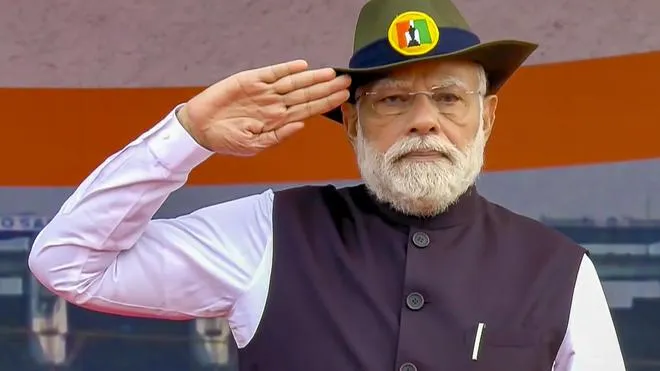
On the occasion of Rashtriya Ekta Diwas—National Unity Day—Prime Minister Narendra Modi paid homage to Sardar Vallabhbhai Patel, reiterating the Iron Man’s role in unifying India after independence. Addressing a gathering in Gujarat’s Kevadia, Modi asserted that Sardar Patel’s vision encompassed the complete integration of Jammu and Kashmir with India, but claimed that this aspiration was hindered by then Prime Minister Jawaharlal Nehru’s decisions. Emphasizing Patel’s enduring legacy, Modi urged citizens to draw inspiration from his leadership, reaffirming the government’s commitment to national unity, sovereignty, and the continued strengthening of India’s territorial integrity.
A Tribute to the Architect of Unity
Prime Minister Narendra Modi led the nation in commemorating Rashtriya Ekta Diwas—observed annually on October 31 to mark the birth anniversary of Sardar Vallabhbhai Patel. At the Statue of Unity in Kevadia, Gujarat, Modi paid floral tributes to the architect of modern India and presided over a series of events celebrating his contributions to national consolidation.
In his address, the Prime Minister lauded Patel’s unparalleled leadership in integrating over 560 princely states into the Indian Union following independence. He described Patel’s diplomatic acumen and firm resolve as foundational to the creation of a unified and sovereign India. “It was Sardar Patel’s courage, foresight, and determination that prevented the balkanization of the country at a critical juncture in history,” Modi said.
The Kashmir Question and Historical Reflections
During his speech, Modi highlighted Patel’s vision regarding Jammu and Kashmir, asserting that Patel was keen on ensuring the full integration of the region into India. He remarked that historical circumstances and policy choices of the early leadership—specifically those of Jawaharlal Nehru—stood in the way of that goal. Modi noted that Patel’s pragmatic approach to statecraft, had it been applied to Kashmir, could have led to a different trajectory for the region.
Without delving into partisan rhetoric, Modi’s remarks rekindled a long-standing debate over the early years of post-independence governance and the divergent approaches taken by Patel and Nehru on national integration and border policy.
Legacy of Sardar Patel in Contemporary India
The Prime Minister emphasized that Patel’s vision remains deeply relevant in the present era, particularly in the context of national security and unity. He drew parallels between Patel’s integration efforts and the government’s recent initiatives to strengthen administrative and developmental frameworks in Jammu and Kashmir.
Modi underscored the significance of the abrogation of Article 370 in 2019, suggesting that it marked a continuation of Patel’s mission to unify India under a single constitutional framework. “Sardar Saheb’s dream of complete unity is being realized through our collective resolve and action,” he stated.
Nationwide Celebrations and Unity Pledge
Across India, Rashtriya Ekta Diwas was observed with unity runs, cultural programs, and public gatherings reaffirming commitment to the ideals of integrity and solidarity. From educational institutions to government offices, citizens took the Ekta Pledge—a symbolic reaffirmation of India’s strength in diversity.
In New Delhi, union ministers, officials, and schoolchildren participated in commemorative events, while state governments organized marathons, exhibitions, and essay competitions celebrating Patel’s contributions. The overarching message resonated nationwide: that unity remains India’s most powerful force amid diversity.
Conclusion: The Enduring Relevance of Patel’s Vision
As the nation commemorates Rashtriya Ekta Diwas, Sardar Vallabhbhai Patel’s legacy continues to serve as a moral and political compass for India’s unity. Prime Minister Modi’s tribute was not merely a remembrance of history but a reminder that the work of nation-building is ongoing.
Patel’s statesmanship, characterized by courage, pragmatism, and unflinching dedication to India’s sovereignty, remains a benchmark for leadership. His ideals continue to inspire contemporary governance, underscoring that the vision of an indivisible, united India remains as vital today as it was seven decades ago.
Comments