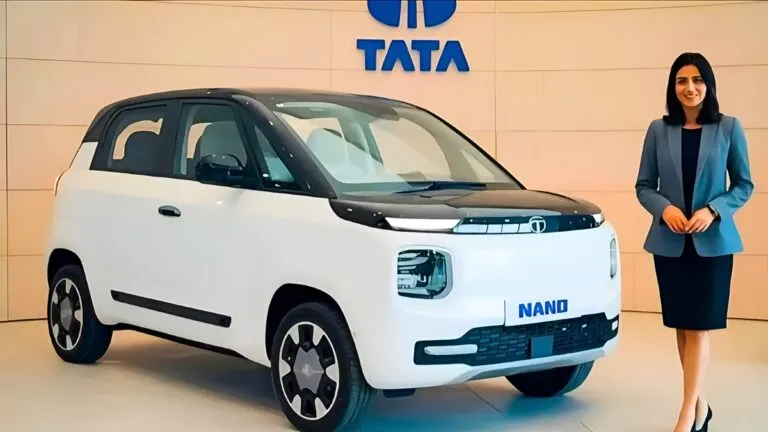
The Tata Nano, once hailed as India’s ultra-affordable “people’s car,” is reportedly poised for a comeback in 2025 under the aegis of Tata Motors. Sources suggest the new model will blend compact dimensions with modern features, delivering significant fuel efficiency and potentially offering electric and CNG options. While the precise official announcement remains pending, speculation points to pricing from Rs. 2.1 lakh to Rs. 6 lakh, depending on powertrain and specification. The revived Nano is designed to address urban mobility, entry-level car ownership and India’s evolving regulatory landscape.
---
Background and Strategic Context
The original Tata Nano launched in 2008, with the promise of a sub-Rs one-lakh car, captured headlines for its ambition to democratise car ownership in India. Over time, however, shifts in consumer expectations, regulatory safety norms and cost inflation reduced its viability. The 2025-era proposal for the Nano signals Tata Motors’ intent to re-enter the ultra-compact segment with contemporary credentials—aligning with India’s push toward electrification, urban mobility solutions and affordability.
From a business-perspective, reviving the Nano allows Tata to target first-time buyers, tier-2 and tier-3 city markets, and possibly drive volume through lower cost powertrains. It also helps fill the lower rungs of Tata’s portfolio below models like the Tiago, Punch and Altroz.
---
What We Know So Far: Features and Specifications
While official details have not been formally confirmed by Tata Motors, multiple credible automotive industry reports outline expected specifications:
Powertrain options: A small petrol engine (possibly 624 cc or 800 cc) with manual or AMT, alongside potential electric (EV) and CNG versions.
Fuel efficiency/Range: The petrol version is touted to deliver up to 40 km per litre under ideal conditions; EV variants are claimed to provide ranges of 150-250 km.
Technology and safety features: Expectation of a 7-inch touchscreen infotainment system with smartphone connectivity, dual front airbags, ABS with EBD, ISOFIX child-seat mounts and a reinforced body shell.
Pricing and variants: Petrol versions are estimated to start around Rs. 2.1 lakh – Rs. 4 lakh, while EV variants may cost Rs. 4.5 lakh – Rs. 6 lakh or higher (ex-showroom) depending on battery and features.
---
Market Implications and Risks
From a business-analyst viewpoint, the resurrection of the Nano brings both opportunity and risk. On the opportunity side:
Volume growth potential: By occupying an entry-level price band, Tata may stimulate first-time car purchases, especially in urban and semi-urban India.
Cost leadership feature: With a lower cost base, the Nano could complement Tata’s higher-priced models, enabling brand loyalty early in a buyer’s lifecycle.
EV strategy alignment: If an electric version materialises, it supports India’s electrification policies and allows Tata to leverage its EV infrastructure.
However, the risks are material:
Regulatory/safety constraints: Modern safety and emissions norms require investment; balancing ultra-low cost with compliance is challenging.
Brand perception: The original Nano faced criticism on build quality and safety; Tata will need to overcome legacy perceptions.
Profitability margins: At very low price points, margin squeeze is real. Tata must ensure scale and operational efficiency.
Cannibalisation vs. portfolio coverage: The Nano must not cannibalise other Tata models (Tiago, Altroz) but rather complement the product mix.
---
Strategic Insight: What’s at Stake?
The successful launch of the 2025 Nano could redefine the sub-Rs 5 lakh mobility segment in India. It could catalyse carification in smaller towns, promote EV uptake if applicable, and enable Tata to reinforce its leadership in volume markets. For buyers, the promise is clear: modern features, connectivity, safety and affordability packaged into a compact car designed for urban landscapes.
Yet, the strategic integrity lies in execution. The supply chain, cost engineering, dealer readiness and post-sales support must all perform. If Tata delivers on aspirations while managing costs, the Nano’s revival may be a case study in frugal innovation and mass mobility. If not, it risks being a nostalgia-driven headline rather than a commerce-driven win.
---
Conclusion
In sum, the Tata Nano 2025 is emerging as more than a mere retro-launch—it represents a strategic pivot by Tata Motors toward affordable, feature-rich and potentially electrified mobility for India’s growing urban populace. The proposition is compelling: low price, modern tech, high efficiency. But the real test will be whether the company can deliver on promises while sustaining profitability and navigating regulatory, perception and cost pressures. For now, the market watches keenly.
Comments