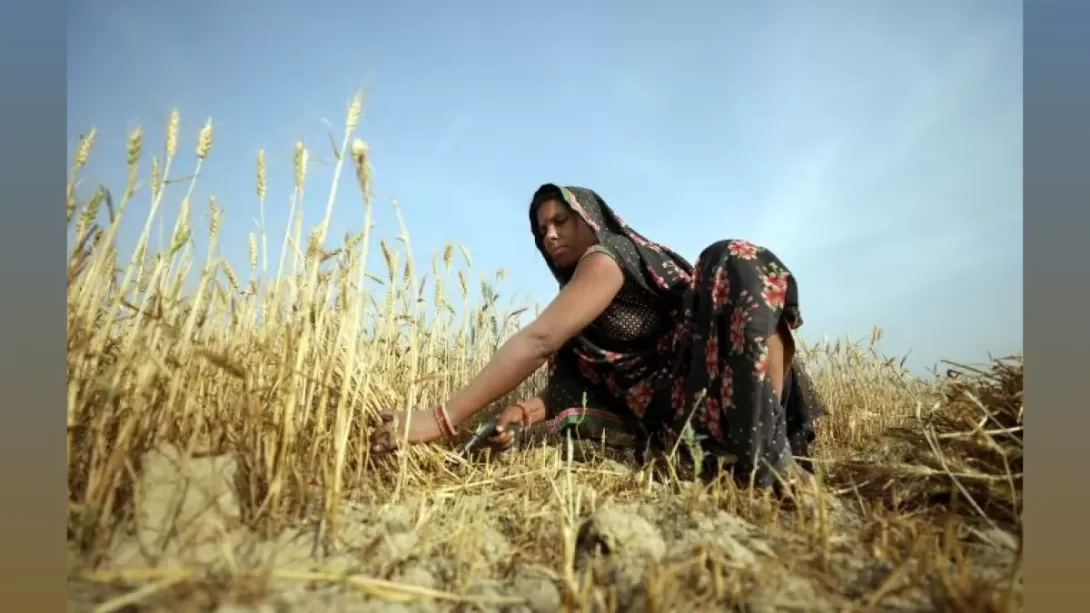
The Indian government has approved an increase in the Minimum Support Prices (MSP) for all mandated Kharif crops for the 2025–26 marketing season, a move welcomed by the Haryana government as part of its broader promise to double farmers’ income. However, the decision has ignited sharp political criticism, with opposition voices labeling the increase as insufficient in light of soaring input costs and inflation. While state officials lauded the hike as progressive, critics argue that the policy falls short of providing meaningful economic relief to struggling farmers, calling for full implementation of the Swaminathan Commission’s recommendations.
Government Greenlights MSP Increase for Kharif Crops
In a key policy move ahead of the sowing season, the Cabinet Committee on Economic Affairs (CCEA), chaired by Prime Minister Narendra Modi, approved the agriculture ministry’s proposal to revise the MSP for the 2025–26 Kharif marketing season. The revision encompasses several key crops, reflecting the administration’s stated objective to enhance farm incomes and strengthen agricultural sustainability.
Haryana Chief Minister Nayab Singh Saini welcomed the decision, framing it as a reaffirmation of the government’s commitment to doubling farmer income. “This is a decisive step toward rural prosperity,” Saini noted, highlighting the significance of timely MSP announcements for crop planning and farm-level financial decisions.
Detailed Breakdown of MSP Hikes
The newly approved MSP rates exhibit incremental gains across a spectrum of essential crops. Notable revisions include:
- Paddy (Common Grade): Increased from Rs. 2,300 to Rs. 2,369 per quintal — an 81% rise compared to the 2013–14 benchmark.
- Paddy (A-Grade): Revised from Rs. 2,320 to Rs. 2,389 per quintal — marking a 78% increase over the 2013–14 rate.
- Moong Dal: Elevated from Rs. 8,682 to Rs. 8,768 per quintal — reflecting a 95% rise from 2013–14 levels.
- Bajra: Hiked from Rs. 2,625 to Rs. 2,775 per quintal — a 122% jump over a decade.
- Ragi: Raised from Rs. 4,290 to Rs. 4,886 per quintal — a 226% increase since 2013–14.
- Maize: Revised upward from Rs. 2,225 to Rs. 2,400 per quintal — representing an 83% increase.
- Tur/Arhar: Enhanced from Rs. 7,550 to Rs. 8,000 per quintal — an 86% rise.
These adjustments are aimed at ensuring remunerative prices for farmers while encouraging diversified cropping patterns.
Policy Timing and Impact on Farmer Decision-Making
By announcing MSP rates ahead of the sowing season, the government intends to provide farmers with sufficient time and data to make informed decisions about crop selection. This proactive measure seeks to enhance farm-level productivity, reduce crop volatility, and align sowing patterns with market trends and agro-climatic suitability.
According to government statements, the policy aligns with previous efforts to offer predictable, transparent pricing mechanisms. It also dovetails with broader agricultural policy objectives outlined in the National Agriculture Policy, which emphasizes sustainability, income stability, and modernization.
Opposition Critique: "Symbolic, Not Substantive"
Despite the headline increase, political opposition figures, notably former Haryana Chief Minister Bhupinder Singh Hooda, have voiced strong dissent. Hooda criticized the hike as “tokenistic,” arguing that the Rs. 69 per quintal increase in paddy is negligible when juxtaposed with the dramatic rise in inflation and input costs.
“In our tenure, MSPs were increased by nearly 14%–15% annually. Today’s announcement is merely a gesture rather than real support,” Hooda asserted. He accused the government of using MSP announcements as a ritualistic pre-election exercise, while failing to enforce actual procurement at those prices.
Hooda further cited rampant inflation, rising diesel and fertilizer prices, and unaddressed weather-related crop damage as compounding challenges that make farming economically unsustainable for many. He reiterated demands for the implementation of the Swaminathan Commission’s recommendations, including the adoption of the C2+50 pricing formula that factors in comprehensive cost inputs.
Swaminathan Commission and the Call for Structural Reform
Central to the opposition’s argument is the demand for the full implementation of the Swaminathan Commission’s formula, which recommends that MSPs be set at 50% above the total cost of production (C2). This includes imputed costs such as family labor, land rental value, and capital depreciation—elements not fully captured under the current formula (A2+FL).
Critics argue that without transitioning to this more expansive pricing framework, periodic MSP hikes will continue to fall short of delivering real income security to farmers. In practice, private procurement agents often purchase crops at prices well below MSP due to lack of enforcement and inadequate government procurement infrastructure.
Conclusion: Policy Signal or Practical Relief?
The revised MSPs for the 2025–26 Kharif season highlight the government’s strategic intent to position agriculture as a pillar of economic growth. However, the ongoing political contestation underscores deeper structural issues within India’s agricultural economy—from inflation and supply chain inefficiencies to weak procurement enforcement and climate vulnerability.
As the sowing season approaches, the effectiveness of the MSP hike will be judged not only by the quantum of increase but also by its real-world implementation, impact on farmer livelihoods, and ability to catalyze broader rural economic development.
Comments