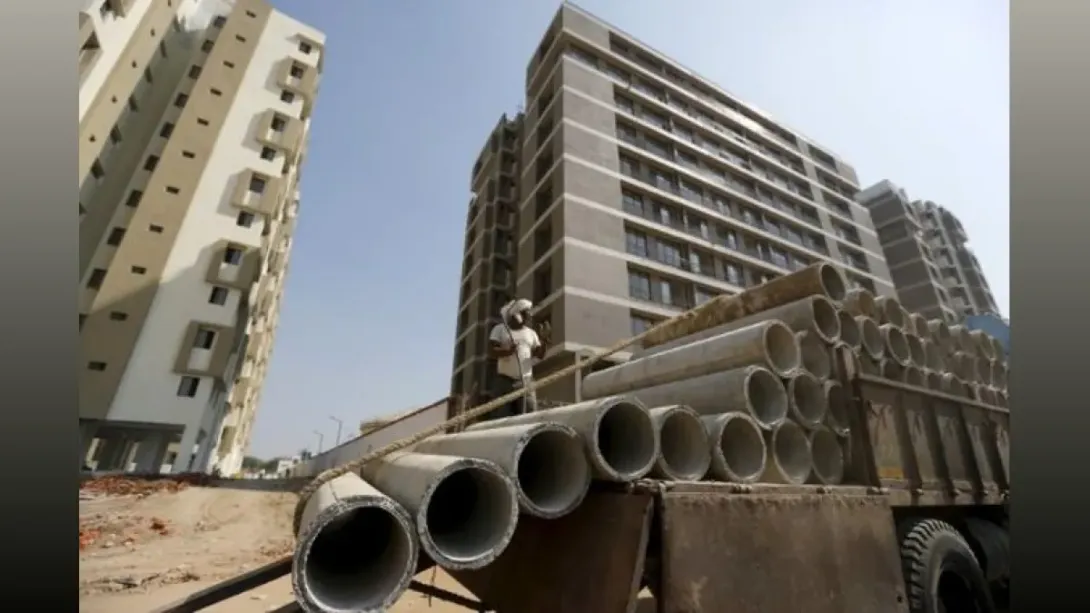
India’s real estate landscape presented a mixed outlook in the first half of 2025, with robust growth in the office leasing segment contrasting with a marginal dip in residential sales. According to data released by Knight Frank, housing sales across eight major cities declined by 2% year-on-year to 1.7 lakh units, while office leasing rose sharply by 41% to 48.9 million square feet. This divergence underscores shifting priorities in post-pandemic real estate, with demand surging for commercial properties, especially in IT and business hubs. Despite subdued housing numbers, premium residential segments continue to attract strong interest, reflecting nuanced market dynamics.
Commercial Real Estate Booms Amid Corporate Expansion
The Indian office space market experienced an exceptional first half in 2025, signaling continued confidence from domestic and multinational corporations alike. Gross office space leasing rose to 48.9 million square feet between January and June, representing a 41% year-on-year jump. This surge follows a record-breaking 71.9 million square feet leased in the entire 2024, and experts now anticipate a new high of 80–90 million square feet by the end of the current calendar year.
This upward trajectory reflects India’s strengthening position as a global hub for professional services, IT, and innovation. Corporates are increasingly investing in modern, high-spec office spaces to accommodate hybrid work models, technology-driven operations, and expansion plans.
Cities such as Bengaluru, Delhi-NCR, Pune, and Kolkata led the charge, with Bengaluru alone witnessing a remarkable 120% growth in leasing volume—rising to 18.2 million square feet. Delhi-NCR followed with 7.2 million square feet, marking a 27.5% increase. Chennai, too, recorded a 68% surge to 5.1 million square feet. Kolkata, often a quieter player, posted a surprising 60% rise to 1.1 million square feet.
Conversely, Mumbai saw a 5% decline, while Ahmedabad experienced the sharpest fall of 51% in leasing activity, ending the period at just 0.8 million square feet.
Residential Sales See Marginal Decline, But Premium Demand Endures
While the commercial market flourished, the residential segment recorded a modest contraction. Total housing sales across India’s top eight property markets fell 2% year-on-year, landing at 1,70,201 units in H1 2025. This comes despite notable appreciation in housing prices, which rose between 2% and 14% across cities.
Interestingly, consumer preferences skewed significantly toward premium housing. Homes priced at Rs. 1 crore and above accounted for 49% of all residential transactions during the period, while the remaining 51% fell under the Rs. 1 crore category. This bifurcation highlights an evolving buyer profile—more affluent, urban-centric, and quality-conscious.
Performance varied across metros. Mumbai, India’s largest property market, remained flat at 47,035 units, as did Ahmedabad at 9,370 units. Delhi-NCR, however, saw an 8% decline to 26,795 units, while Bengaluru recorded a 3% dip to 26,599 units. Pune witnessed a marginal drop of 1% to 24,329 units, and Kolkata suffered the steepest fall at 11%, closing at 8,090 units.
Conversely, southern markets showed resilience. Hyderabad’s housing sales increased by 3% to 19,048 units, and Chennai posted a solid 12% growth to 8,935 units.
Knight Frank’s Chairman and Managing Director, Shishir Baijal, remarked that the residential market's performance reflected a clear segmentation—luxury and high-value properties continue to thrive, while affordable and mid-tier segments appear to be stabilizing after recent booms.
Real Estate Trends Signal Structural Shifts
The contrasting trajectories of commercial and residential segments underscore broader structural shifts in India’s real estate sector. On the commercial front, the surge in demand is driven by a combination of economic expansion, global outsourcing momentum, and occupier confidence in India’s long-term business environment.
Meanwhile, the residential market is experiencing a bifurcation—while demand for mid-range housing is plateauing due to affordability constraints, the luxury segment is benefiting from rising incomes, wealth creation in tech and entrepreneurship, and renewed interest in lifestyle-oriented living.
Baijal summed it up by stating, “This performance is a testament to India’s resilient economic fundamentals and its growing prominence as a global business hub.” He also emphasized that the sustained demand for quality workspaces indicates occupiers’ long-term confidence in India's economic and infrastructural growth.
Outlook: Navigating Growth Amid Evolving Consumer Behavior
As the second half of 2025 unfolds, the Indian real estate market is poised for further divergence. The commercial segment is expected to set new records, bolstered by international capital, rapid urban development, and continued digital transformation.
On the residential side, developers may focus more on premium offerings, customization, and gated communities that align with post-pandemic lifestyle preferences. Affordability and interest rates, however, will remain key factors influencing demand in the mass housing segment.
India’s real estate ecosystem is entering a phase marked by maturity, specialization, and global integration. While cyclical adjustments are inevitable, the sector’s strategic pivot toward quality, sustainability, and innovation positions it well for long-term resilience.
Comments