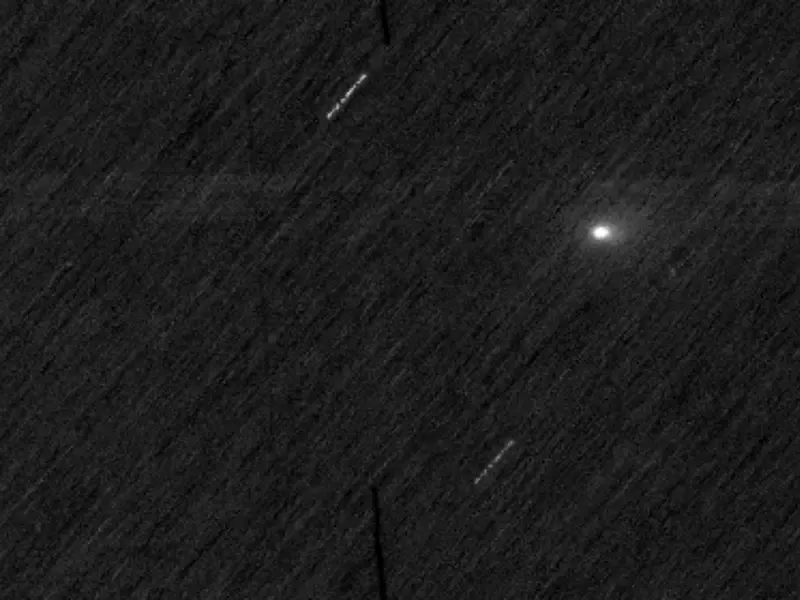
Astronomers are intensively studying 3I/ATLAS, an interstellar comet that has entered our solar system, offering an unprecedented glimpse into materials from distant star systems. Detected in early 2025, this rare celestial object carries primordial dust and gas, providing critical insights into planetary formation and the composition of other stellar environments. Researchers are employing advanced telescopes and spectroscopy to analyze its trajectory, chemical makeup, and tail dynamics. Beyond expanding scientific knowledge, 3I/ATLAS underscores the importance of rapid detection, space observation networks, and international collaboration to study fleeting interstellar phenomena, potentially informing models of cosmic evolution and the origins of planetary systems.
Discovery and Trajectory
3I/ATLAS, officially catalogued in January 2025, is only the second confirmed interstellar comet observed passing through the solar system. Traveling at speeds exceeding 100 km/s relative to the Sun, its hyperbolic trajectory confirms an extrasolar origin. Astronomers worldwide have mobilized to track its path, using both ground-based observatories and space telescopes to capture high-resolution imagery and spectrographic data before it recedes into interstellar space.
Chemical Composition and Scientific Insights
Preliminary analyses indicate that 3I/ATLAS carries volatile compounds, dust, and organic molecules preserved from its parent system. By studying these materials, scientists can compare them with solar system comets, revealing differences in chemical evolution, isotopic ratios, and potential prebiotic elements. Such data may illuminate how planetary systems form and evolve, and offer clues about the distribution of life-forming molecules across the galaxy.
Observational Challenges and Techniques
Due to its rapid movement and faint magnitude, observing 3I/ATLAS presents logistical and technical challenges. Researchers are utilizing spectroscopy, photometry, and adaptive optics to dissect its coma and tail structure. Coordinated international monitoring ensures maximal data collection, emphasizing the necessity of robust early-warning systems and global scientific networks to study transient interstellar visitors.
Broader Implications for Astronomy
The study of 3I/ATLAS advances understanding of interstellar material exchange and the diversity of planetary systems. Insights gained from its analysis may inform future missions, including sample-return projects and interstellar probe planning. Furthermore, it highlights the critical role of space-based observation platforms in complementing terrestrial telescopes, ensuring comprehensive coverage of fleeting cosmic phenomena.
Conclusion
3I/ATLAS represents a rare and invaluable opportunity to investigate the building blocks of distant star systems. As scientists decode its chemical and physical properties, the comet promises to deepen knowledge of cosmic origins, interstellar travel, and the universal processes shaping planetary systems. Its fleeting visit underscores the importance of agility, collaboration, and technological innovation in contemporary astronomy.
Comments