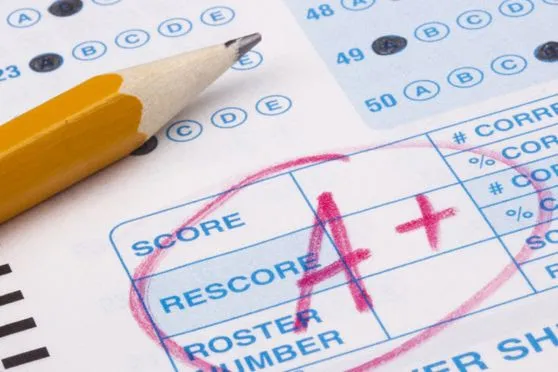
In a significant reform of India’s school examination ecosystem, the Punjab School Education Board has announced the adoption of a comprehensive on-screen marking system for the March 2026 board examinations, following similar steps by the Central Board of Secondary Education. Punjab Education Minister Harjot Singh Bains described the move as a structural transformation aimed at enhancing transparency, speed and accuracy in evaluation. The initiative introduces QR-coded answer sheets, centralized scanning and automated mark calculation, positioning Punjab at the forefront of digital academic governance.
A Structural Shift in Academic Evaluation
The Punjab School Education Board has formally transitioned toward an end-to-end digital evaluation framework for its upcoming Class 10 and Class 12 board examinations in 2026. The reform introduces an on-screen marking (OSM) mechanism under which answer scripts will be scanned and uploaded to a centralized digital platform for assessment.
Education Minister Harjot Singh Bains characterized the move as a fundamental overhaul rather than a procedural adjustment. According to the minister, the system is designed to reduce human error, eliminate calculation discrepancies and accelerate result processing timelines.
The announcement places Punjab among the earliest state boards in India to implement a fully digitized evaluation architecture at scale.
How the On-Screen Marking System Works
Under the new protocol, each answer booklet will carry a unique QR code to facilitate secure identification and digital tracking. After examinations conclude, answer sheets will be scanned and uploaded to a centralized dashboard accessible to authorized evaluators.
Teachers will assess responses online using structured marking rubrics embedded within the system. The software will automatically compute total marks, minimizing arithmetic inaccuracies and standardizing score aggregation.
The board has also incorporated real-time progress monitoring tools, enabling administrative oversight and timely intervention if evaluation bottlenecks arise.
Pilot Success and Data-Driven Confidence
The digital framework is not being introduced without precedent. During supplementary examinations conducted in September 2025, approximately 23,000 answer scripts were evaluated using the on-screen marking process. Officials reported accurate and streamlined results, bolstering confidence in the scalability of the model.
Such pilots serve as proof-of-concept exercises in public-sector digitization. By leveraging controlled trial data, the board aims to mitigate systemic risk before expanding the initiative across all subjects and classes.
Implementation Timeline for 2026 Examinations
For the 2026 academic cycle, Class 12 examinations will be conducted from February 17 to April 4, while Class 10 examinations are scheduled between March 6 and March 27.
Initially, the OSM system will be implemented in one subject of the Class 10 examination, with phased expansion planned in subsequent years. Class 12 evaluation will see broader adoption in alignment with administrative readiness and technological preparedness.
Meanwhile, the Central Board of Secondary Education has introduced on-screen marking for Class 12 examinations and partial evaluation components in Class 10. However, offline assessment will continue for certain papers at the national level.
Governance, Transparency and Educational Economics
Beyond administrative efficiency, the reform signals a broader recalibration of educational governance. Digitized evaluation reduces logistical costs associated with physical answer sheet transportation, manual compilation and decentralized marking centers. Over time, this could translate into measurable fiscal efficiencies and improved resource allocation.
More importantly, the system strengthens transparency and auditability. Digital trails enable traceable evaluation records, reducing disputes and reinforcing institutional credibility.
For students and parents, faster result declaration enhances planning certainty for higher education admissions and competitive examinations. For policymakers, the move aligns with broader digital transformation initiatives shaping India’s public infrastructure.
A Student-Centric Reform
PSEB Chairman Amarpal Singh emphasized that the transition reflects a student-first philosophy, asserting that technological modernization must ultimately serve fairness and equity in assessment.
Education reforms often falter at the implementation stage. However, the structured rollout of on-screen marking — supported by pilot data, phased adoption and administrative oversight — suggests a calibrated strategy rather than symbolic digitization.
As India’s education boards navigate rising enrollment numbers and heightened expectations for accountability, Punjab’s experiment may well become a template for scalable academic reform. In an era where data integrity and institutional trust define governance standards, digital evaluation is not merely innovation — it is structural evolution.
Comments