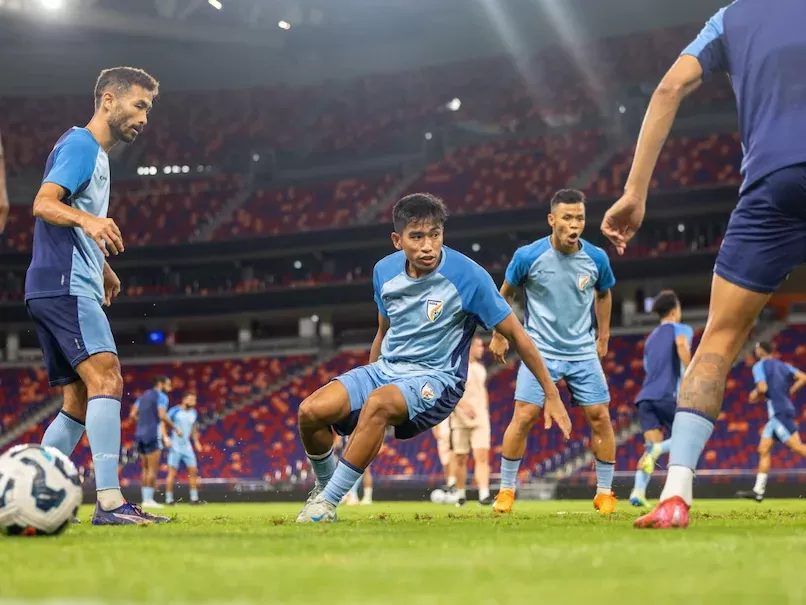
Indian football icon Bhaichung Bhutia has sharply criticized the All India Football Federation (AIFF) following the national team’s 0–1 defeat to Hong Kong in the AFC Asian Cup 2027 Qualifiers. In a scathing assessment, Bhutia questioned the AIFF’s decision-making—particularly a sudden promise of a USD 50,000 bonus for a potential win—calling it arbitrary and emblematic of deeper systemic failures. He also urged AIFF President Kalyan Chaubey to resign, citing consistent underperformance and administrative instability. The former captain's remarks come at a time when India’s footballing hopes hang in the balance, both regionally and internationally.
Mounting Losses, Mounting Questions
India's defeat against Hong Kong, following a lacklustre draw with Bangladesh, has all but ended its campaign in the AFC Asian Cup 2027 Qualifiers. The team conceded a late stoppage-time penalty, further extending its winless streak in international competitions. The last win before this drought came over 16 months ago, a 3–0 victory against the Maldives, led by the now-retired and briefly-returned Sunil Chhetri.
Despite a promising FIFA ranking of 99 in July 2023 and a string of regional victories—including the Intercontinental Cup and SAFF Championship—India’s performance since then has unravelled. The national team failed to register a single win throughout 2024, crashing out of the FIFA World Cup 2026 qualification rounds.
Incentives Without Infrastructure
At the heart of Bhutia’s criticism lies the AIFF’s opaque and seemingly impulsive reward system. Reports emerged that players were promised a USD 50,000 (approximately Rs. 41.7 lakh) bonus for a win against Hong Kong. The sudden nature of the announcement, according to Bhutia, exposed the lack of any coherent incentive structure within the federation.
"Where is the consistency?" Bhutia asked, underscoring that many players have not even received their basic daily allowance of Rs. 2,500. “These aren’t cricketers earning crores. For footballers, every rupee counts. Making such a large bonus announcement without fixing the fundamentals is absurd.”
The former captain pointed out that unlike the BCCI, the AIFF does not offer central contracts to players, leaving many reliant on match allowances and club salaries. Such a bonus, he argued, raises questions about fairness, planning, and sustainability.
Leadership Under Fire
Bhutia reserved his strongest criticism for AIFF President Kalyan Chaubey. Citing a lack of strategic vision and administrative instability, he called for Chaubey’s immediate resignation. “It’s been a terrible two and a half years under his leadership. Both on and off the pitch, Indian football has regressed,” he said.
The tenure has seen controversies over coach appointments, contract disputes, and broader governance concerns. Former head coach Igor Stimac’s contentious departure only added to the disarray, with the national team appearing rudderless during crucial qualification stages.
Bhutia emphasized that the leadership crisis is not just a sporting concern but a systemic one, threatening the very structure of football development in India. As other Asian nations such as Uzbekistan move forward and secure World Cup berths, India's stagnation is more glaring than ever.
An Urgent Need for Reform
With the possibility of missing the 2027 Asian Cup—a competition India has routinely qualified for in recent editions—the urgency for change is palpable. Bhutia’s call to action reflects a growing chorus among former players, analysts, and fans who feel Indian football is in need of a systemic overhaul.
Strategic planning, grassroots development, transparency in player welfare, and stable governance are just a few of the reforms urgently needed. Temporary financial carrots, Bhutia warned, can neither motivate players nor mask institutional failures.
Conclusion: A Crossroads for Indian Football
India’s footballing future stands at a crossroads. Bhaichung Bhutia’s impassioned appeal for accountability and reform is not merely a critique—it is a wake-up call. With national pride, player livelihoods, and regional competitiveness at stake, the AIFF must move beyond reactionary decisions and embrace structural, long-term development strategies.
Whether or not Chaubey steps down, what Indian football needs now is a clear roadmap—a vision rooted in transparency, professionalism, and sustainable growth. Anything less risks squandering a generation of potential and passion.
Comments